Indoor air can change significantly throughout the day, even when everything in a room appears normal. Cooking, cleaning products, furniture, paints, electronics, poor ventilation, dust, smoke and everyday human activity can all affect indoor environmental conditions.
A DIY indoor air quality monitor gives you a practical way to observe those changes instead of relying on guesswork.
With an ESP32 and the right combination of environmental sensors, you can build a compact monitoring device capable of measuring parameters such as temperature, humidity, volatile organic compounds (VOCs), particulate matter, carbon dioxide or equivalent CO₂ values, depending on the sensors you choose.
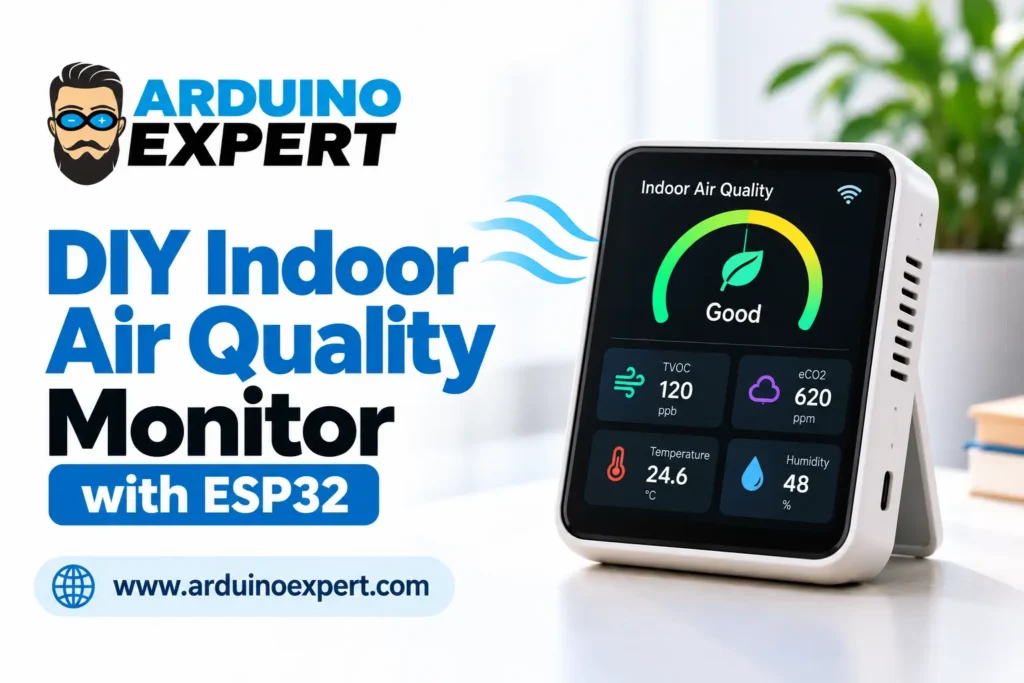
In this guide, we will look at how to design an ESP32 indoor air quality monitor, which sensors are suitable for different pollutants, what each measurement actually means, and how these ideas were applied in our own smart air quality monitoring project called Birdy.
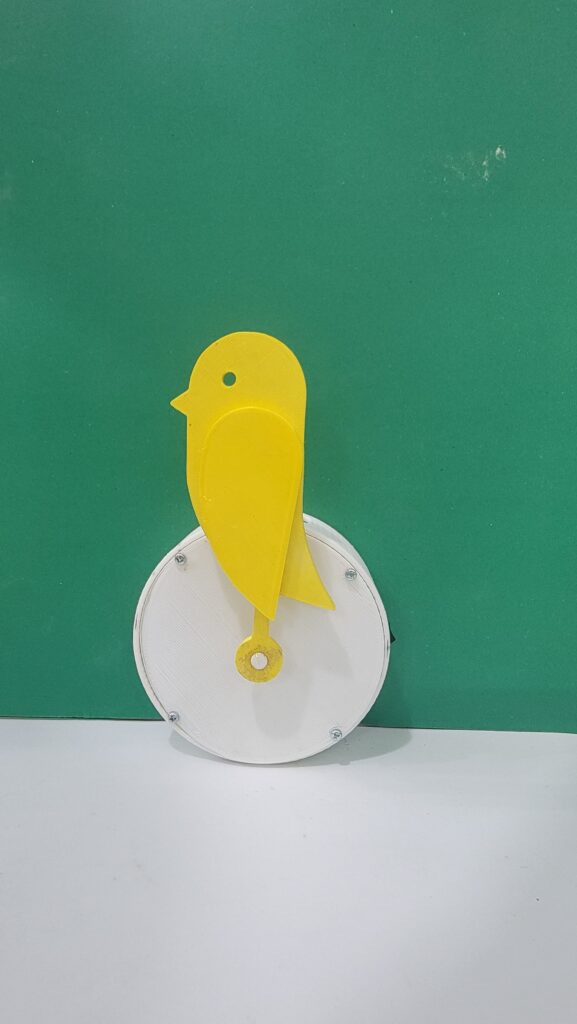
Birdy is an ESP32-based portable indoor environmental monitor developed by Arduino Expert using an ENS160 air-quality sensor, AHT21 temperature and humidity sensor, BLE connectivity, rechargeable battery system, mobile application and a servo-controlled physical air-quality indicator.
Rather than concentrating on one particular circuit or sensor library, this guide will help you understand the overall architecture so you can choose the right hardware for your own DIY air quality monitor ESP32 project.
What Is a DIY Indoor Air Quality Monitor?
A DIY indoor air quality monitor is an electronic device that uses environmental sensors to measure one or more characteristics of indoor air.
Depending on the design, an indoor monitoring system may measure:
- Temperature
- Relative humidity
- Volatile organic compounds (VOCs)
- Total volatile organic compounds (TVOC)
- Equivalent CO₂ (eCO₂)
- True carbon dioxide (CO₂)
- PM1.0
- PM2.5
- PM10
- NOx
- Barometric pressure
- Other gases or environmental parameters
The microcontroller collects readings from these sensors, processes the measurements and then presents the information to the user.
The output might be displayed through:
- An OLED or LCD display
- RGB LEDs
- A buzzer
- Wi-Fi dashboard
- Home Assistant
- MQTT
- Bluetooth Low Energy
- Mobile application
- Cloud dashboard
- Physical movement or another interactive indicator
The US EPA notes that indoor pollutants can include both particles and gases, including particulate matter, volatile organic compounds, formaldehyde, pollen and other contaminants. Indoor conditions can also change substantially throughout the day.
This is why there is no single sensor that represents every aspect of indoor air quality.
A good indoor air quality monitoring system starts by deciding exactly what you want to measure.
Why Use ESP32 for an Indoor Air Quality Monitor?
ESP32 is an excellent platform for a DIY environmental monitoring device because a single controller can manage sensing, data processing and wireless communication.
Depending on the ESP32 variant and project requirements, it can provide:
- I²C sensor communication
- SPI communication
- UART communication
- ADC inputs
- Wi-Fi
- Bluetooth Low Energy
- GPIO control
- PWM for buzzers, LEDs and servo motors
- Low-power operating modes
- Enough processing capability for sensor algorithms and user interfaces
This makes it possible to build anything from a simple ESP32 air quality sensor to a complete connected IoT product.
For example, the basic system architecture might look like this:
Air-quality sensors → ESP32 → Data processing → Display / BLE / Wi-Fi → User
A more sophisticated ESP32 air quality monitoring system can also add historical data, alerts, battery management, mobile applications or home automation.
In Birdy, the ESP32 performs several jobs simultaneously. It communicates with the environmental sensors, processes air-quality information, controls a servo and buzzer, manages BLE communication and sends measurements to a custom mobile application.
What Should an Indoor Air Quality Monitor Measure?
Before selecting sensors, it is important to understand that the phrase air quality represents several different environmental factors.
A sensor designed to detect VOC changes does not automatically measure particulate matter, and an eCO₂ value should not be confused with a direct CO₂ measurement.
For a DIY project, the most useful parameters usually fall into the following categories.
1. Temperature
Temperature is one of the simplest environmental measurements, but it provides important context for comfort and other sensor readings.
It can also influence gas-sensor behavior.
Common temperature and humidity sensors used with ESP32 include:
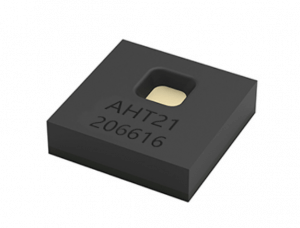
- AHT21
- SHT31
- SHT40/SHT41
- BME280
- BME680/BME688
2. Relative Humidity
Humidity affects comfort, condensation and the behavior of some environmental sensors.
A dedicated temperature and humidity sensor is therefore useful even when the primary purpose of the project is VOC or gas monitoring.
Some gas sensors also accept temperature and humidity compensation values to improve their environmental response.
Contact Arduino Expert for Custom Weather Station Product Development Services
3. VOC and TVOC
VOC means volatile organic compound.
VOCs can originate from many indoor sources such as cleaning products, paints, furniture, adhesives and other materials.
Sensors designed for indoor gas monitoring typically react to a mixture of gases rather than identifying every chemical independently.
For DIY projects, common VOC-oriented sensor options include:
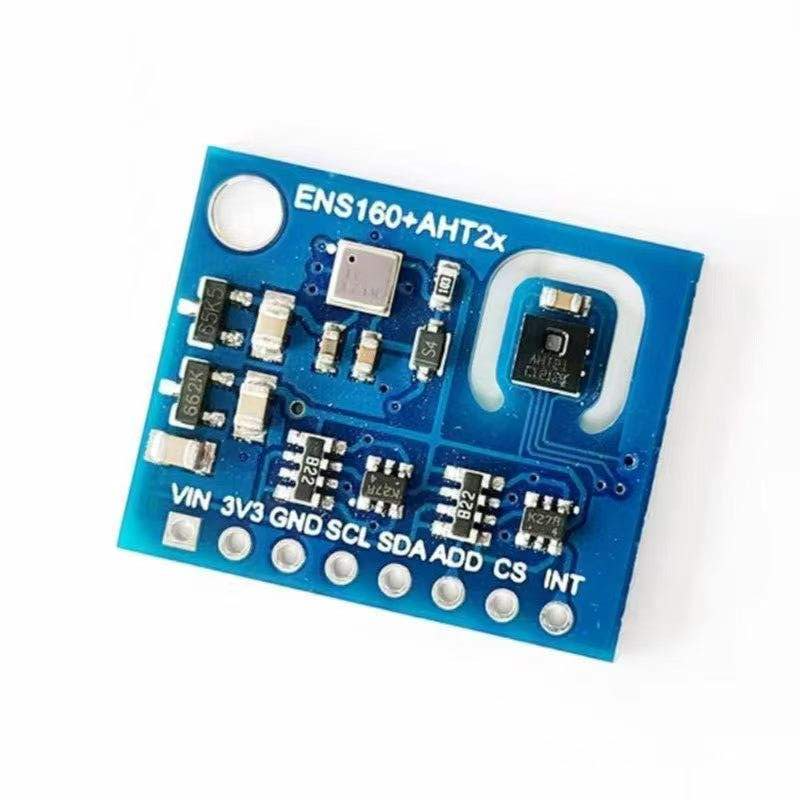
- ENS160
- SGP40
- BME688
- BME680
- CCS811
The Sensirion SGP40, for example, is specifically designed as a digital VOC sensor for indoor-air applications and provides data that can be processed into a VOC Index.
4. eCO₂
You will frequently see inexpensive air-quality modules advertising CO₂, eCO₂, TVOC and AQI.
The distinction between CO₂ and eCO₂ is important.
eCO₂ means equivalent carbon dioxide.
A VOC/gas sensor such as the ENS160 detects changes in gases and uses an algorithm to produce a CO₂-equivalent value.
It is not measuring carbon dioxide through the same physical principle as a dedicated NDIR or photoacoustic CO₂ sensor.
ScioSense describes the ENS16x family as metal-oxide multi-gas sensors that calculate processed outputs including CO₂-equivalents, TVOC-equivalents and air-quality indexes.
Therefore, a project built around an ENS160 can accurately be described as an:
- ESP32 eCO₂ monitor
- ESP32 TVOC monitor
- VOC air quality monitor
- Indoor air quality monitor
But it should not be presented as a precision NDIR CO₂ meter.
5. True CO₂
If actual carbon dioxide concentration is one of your primary requirements, use a dedicated CO₂ sensor.
Popular options include sensors such as:
- Sensirion SCD40
- Sensirion SCD41
- MH-Z19C
- Other NDIR or photoacoustic CO₂ modules
The SCD41 uses an optical/photoacoustic NDIR principle and has a specified measurement range of 400–5,000 ppm for its specified accuracy range.
The MH-Z19C is another dedicated NDIR CO₂ module commonly used in indoor monitoring and HVAC applications. It provides UART and PWM interfaces and is available in several measurement ranges.
For a project where ventilation and actual human-generated CO₂ accumulation are the primary concern, a dedicated CO₂ sensor is normally the better approach.
6. PM2.5 and Particulate Matter
Gas sensing and particulate sensing are completely different.
PM2.5 refers to fine airborne particles with an aerodynamic diameter of approximately 2.5 micrometers or less.
If you want your DIY monitor to detect particles from sources such as smoke, dust and aerosols, add a particulate-matter sensor.
Popular options include:
- Sensirion SPS30
- Plantower PMS5003 family
- Sensirion SEN5x/SEN6x platforms
- Other optical laser-scattering PM modules
The Sensirion SPS30 uses laser scattering and reports PM1.0, PM2.5, PM4 and PM10 measurements.
Adding a PM sensor can significantly improve the scope of an indoor environmental monitoring system, but it also affects enclosure design, airflow, power consumption and physical size.
Best Sensors for a DIY Indoor Air Quality Monitor
There is no universal “best indoor air quality sensor.”
The best sensor depends on the pollutant you want to monitor, your budget, required accuracy, power consumption and enclosure size.
Here is a practical comparison.
| Sensor | Main measurements | Good choice for | Important limitation |
|---|---|---|---|
| ENS160 | TVOC/eTVOC, eCO₂, IAQ | Compact VOC/IAQ projects | eCO₂ is not direct CO₂ |
| AHT21 | Temperature, humidity | Low-cost environmental compensation | Does not measure pollutants |
| SGP40 | VOC Index | VOC monitoring | Requires separate T/RH sensor for a fuller monitor |
| BME688 | Gas/VOC, temperature, humidity, pressure | Compact multi-parameter designs | Not a dedicated true CO₂ or PM sensor |
| SCD40/SCD41 | True CO₂ | Ventilation and occupancy-related CO₂ monitoring | Higher cost and power than simple VOC sensors |
| MH-Z19C | True NDIR CO₂ | Budget DIY CO₂ projects | Larger than tiny SMD sensors |
| SPS30 | PM1/PM2.5/PM4/PM10 | Particle monitoring | Larger and higher-power than basic gas sensors |
| SHT41 | Temperature, humidity | High-quality T/RH measurements | No gas measurement |
| BME280 | Temperature, humidity, pressure | General environmental sensing | No VOC or particulate sensing |
| SEN55 | PM, VOC, NOx, temperature, humidity | Multi-parameter air monitor | Larger module |
| SEN66 | PM, VOC, NOx, CO₂, temperature, humidity | Comprehensive IAQ monitor | More complex/costly than a basic DIY design |
Modern integrated sensor platforms can combine many of these measurements. Sensirion’s SEN66, for example, combines PM1, PM2.5, PM4, PM10, temperature, humidity, VOC Index, NOx Index and CO₂ within one sensing platform.
That can simplify system integration, although it may not be necessary for a small or budget-focused project.
ENS160 for an ESP32 Indoor Air Quality Monitor
For Birdy, we selected the ENS160 as the primary gas/air-quality sensor.
The ENS160 is a digital metal-oxide multi-gas sensor designed for indoor-air monitoring.
It can provide processed information including:
- TVOC/eTVOC
- eCO₂
- Air-quality index information
ScioSense states that the ENS16x architecture uses multiple sensing elements and on-chip processing for indoor air-quality measurements, including CO₂-equivalent and TVOC-equivalent outputs.
That makes the ENS160 ESP32 combination attractive for compact DIY devices where VOC-related air-quality changes are important.
Why pair ENS160 with a temperature and humidity sensor?
Environmental compensation is important for gas sensing.
That is why you will frequently see combinations such as:
ENS160 + AHT21 + ESP32
or:
ENS160 + SHT4x + ESP32
Birdy uses the first combination.
The ENS160 handles the gas/IAQ side of the system, while the AHT21 provides temperature and relative humidity.
This creates a compact sensing platform without requiring several large sensor modules.
AHT21 Temperature and Humidity Sensor
The AHT21 is a digital temperature and humidity sensor using an I²C interface.
Its calibrated digital output and small physical size make it convenient for embedded environmental monitoring devices.
In Birdy, AHT21 measurements serve two purposes:
- They provide useful temperature and humidity information to the user.
- They provide environmental context for the gas-sensing system.
The resulting combination:
ESP32 + ENS160 + AHT21
is suitable for a compact DIY indoor air quality monitor focused on VOCs, eCO₂, IAQ, temperature and humidity.
For applications requiring higher-end temperature/humidity sensing, alternatives such as the SHT41 are worth considering. Sensirion specifies typical SHT41 accuracy of approximately ±1.8% RH and ±0.2°C under its specified conditions.
BME680 and BME688 as Alternative IAQ Sensors
Another common approach is to use a Bosch environmental gas sensor.
The BME680 combines:
- Gas sensing
- Temperature
- Relative humidity
- Barometric pressure
Bosch describes it as an integrated environmental sensor aimed at mobile and wearable applications, with gas, pressure, humidity and temperature sensing.
For newer designs, the BME688 is a particularly interesting option.
It retains environmental sensing while adding more advanced gas-sensing capabilities and compatibility with Bosch’s BSEC and AI-related software ecosystem.
A BME688 can therefore be attractive when:
- PCB space is limited
- Temperature, humidity and pressure are also needed
- You want one compact sensor package
- Application-specific gas-response experiments are important
However, it still should not be treated as a replacement for a dedicated particulate-matter sensor or a precision direct CO₂ sensor.
SGP40 for VOC Monitoring
If the primary requirement is VOC monitoring, the Sensirion SGP40 is another strong option.
It is specifically designed for indoor VOC applications and can be used with Sensirion’s VOC algorithm to generate a VOC Index.
It also supports humidity compensation and uses an I²C interface.
An SGP40-based system might therefore use:
ESP32 + SGP40 + SHT41
for VOC, temperature and humidity monitoring.
This is a good example of why sensor selection should be based on the required measurement rather than simply searching for a component labelled “air quality sensor.”
When Should You Add a True CO₂ Sensor?
If the goal of your monitor includes determining when an occupied room needs additional ventilation, a dedicated CO₂ sensor can provide valuable information.
A possible architecture would be:
ESP32 + SCD41 + VOC sensor + temperature/humidity sensor
or a simpler:
ESP32 + SCD41
design if CO₂ is the main parameter of interest.
The SCD41 contains integrated temperature/humidity sensing for compensation and uses photoacoustic NDIR CO₂ technology.
For lower-cost maker projects, an MH-Z19C can also be considered.
The important principle is simple:
Use a dedicated CO₂ sensor when you need direct CO₂ measurement. Use eCO₂ when an estimated CO₂-equivalent value from a gas sensor is appropriate for the project.
Keeping that distinction clear makes a DIY IAQ device technically much more credible.
When Should You Add a PM2.5 Sensor?
An ENS160, SGP40 or BME688 cannot tell you the concentration of airborne particulate matter.
If smoke, fine dust or aerosols are important to your application, add an optical PM sensor.
One common option is the SPS30.
It measures multiple particulate size categories and communicates through I²C or UART.
The challenge is that PM sensors usually need controlled airflow through a sensing chamber. They are therefore larger and generally consume more power than tiny temperature, humidity or gas-sensing ICs.
That matters when designing a:
- Portable air quality monitor
- Battery-powered air quality monitor
- Wearable environmental device
- Very small 3D-printed enclosure
For a permanently powered home-monitoring station, these trade-offs may be less important.
All-in-One Sensor Options
A modern alternative is to use an integrated environmental sensing platform instead of combining many individual sensors.
The Sensirion SEN55 combines:
- Particulate matter
- VOC
- NOx
- Temperature
- Humidity
in one sensor node.
The newer SEN66 goes further by combining particulate matter, VOC, NOx, CO₂, temperature and humidity.
This can simplify development for a comprehensive monitor.
However, individual sensors can still be preferable when:
- Cost needs to be minimized
- The device is battery powered
- Only selected parameters matter
- Very small PCB dimensions are required
- You want greater control over individual sensor selection
Designing the Electronics for an ESP32 Air Quality Monitor
Once the sensing requirements are defined, the electronic architecture becomes much easier.
A basic ESP32 DIY monitor could contain:
Core controller
ESP32 development board or custom ESP32 PCB
Environmental sensors
One or more gas, CO₂, particulate, temperature or humidity sensors
User feedback
OLED, LEDs, buzzer or physical indicator
Connectivity
Wi-Fi and/or BLE
Power
USB, LiPo, 18650 battery or fixed DC supply
Optional storage
Internal flash, microSD card or external/cloud database
A basic wired prototype can be built with development boards and breakout modules.
For a finished IoT product, however, additional engineering considerations become important:
- Power regulation
- Battery charging
- Sensor placement
- Ventilation
- PCB layout
- RF antenna clearance
- Heat isolation
- Connector selection
- Mechanical design
- Firmware reliability
- Enclosure airflow
These details often determine whether a monitor performs consistently outside the breadboard stage.
Example: Birdy DIY Smart Indoor Air Quality Monitor
We explored these design considerations while developing Birdy, our ESP32 smart indoor air quality monitoring device.
Birdy uses:
| Component | Purpose |
|---|---|
| ESP32 | Main controller and BLE communication |
| ENS160 | VOC, eCO₂ and IAQ sensing |
| AHT21 | Temperature and humidity |
| IP5306 | Battery charging and power management |
| 18650 battery | Portable power |
| Servo motor | Physical air-quality feedback |
| Buzzer | Audible alerts |
| Custom mobile app | Live and historical environmental information |
The system architecture is approximately:
ENS160 + AHT21 → ESP32 → BLE → Birdy mobile app
At the same time:
ESP32 → Servo + Buzzer → Physical user feedback
The device therefore acts as more than a conventional sensor box.
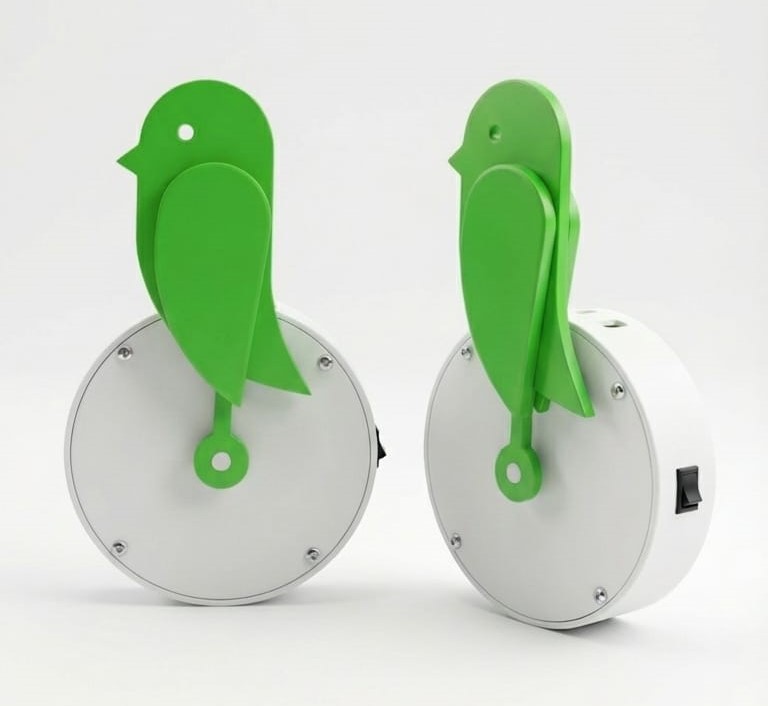
Instead of showing only numerical data, Birdy uses a bird-shaped 3D-printed enclosure and servo-driven movement to represent changes in environmental conditions physically.
Users can also view:
- Indoor air-quality information
- TVOC readings
- eCO₂ readings
- Temperature
- Humidity
- Historical environmental data
- Environmental trends
through the mobile application.
Internal link: Link the phrase Birdy ESP32 Smart Indoor Air Quality Monitoring Device to the existing Birdy project page on Arduino Expert.
This provides readers who want the complete product-development case study with a natural path from this educational article to the actual project.
Bluetooth vs Wi-Fi for an Air Quality Monitor
ESP32 supports both Wi-Fi and Bluetooth Low Energy, so either approach can work.
Wi-Fi
Wi-Fi is useful for:
- MQTT
- Home Assistant
- Web dashboards
- Cloud logging
- Remote monitoring
- Multiple-room sensor networks
It is especially suitable for permanently powered devices.
Bluetooth Low Energy
BLE is attractive for:
- Portable monitors
- Battery-powered sensors
- Direct smartphone communication
- Local monitoring without cloud dependence
Birdy uses BLE because the design is portable and communicates directly with its custom mobile application.
Therefore, if you are building a BLE air quality monitor ESP32 project, think carefully about connection intervals, sensor sampling rate and power management.
Adding a Mobile App
A basic DIY monitor can simply show measurements on an OLED.
But an air quality monitor with a mobile app can provide a much better user experience.
The app can display:
- Current air-quality status
- Temperature and humidity
- TVOC
- eCO₂ or CO₂
- PM2.5
- Historical graphs
- Battery condition
- Alerts
- Device connection status
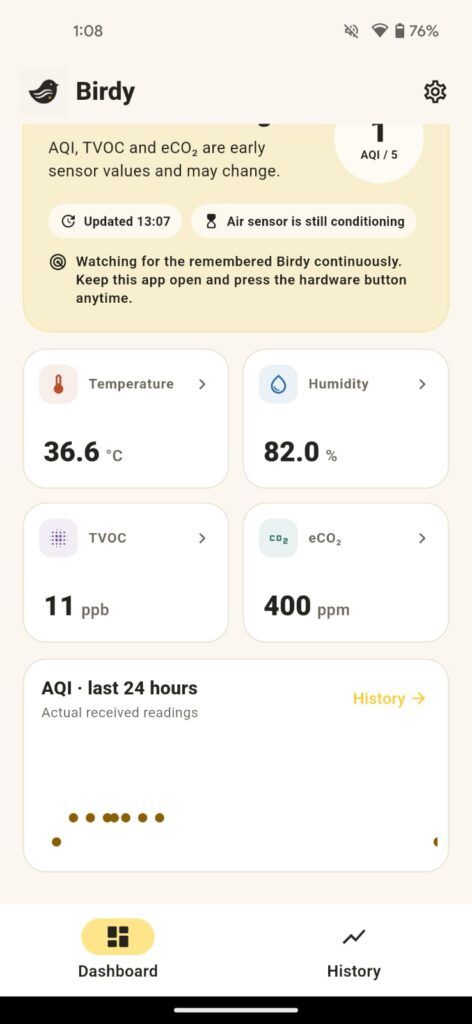
A smartphone interface also lets you remove a large display from the hardware, which can reduce enclosure size and potentially lower power consumption.
In Birdy, the app communicates with the ESP32 through BLE and provides both real-time and historical environmental data.
Powering a Portable Air Quality Monitor
Power design depends heavily on sensor selection.
A simple ESP32 and temperature/humidity sensor can operate with relatively modest power.
Adding components such as:
- PM sensor fans
- NDIR CO₂ sensors
- Displays
- Servo motors
- Always-on Wi-Fi
can substantially change the battery requirements.
For Birdy, we used:
18650 battery + IP5306 power-management system
to create a rechargeable portable design.
When creating your own battery-powered air quality monitor, consider:
- Average sensor current
- Peak ESP32 radio current
- Servo or actuator current
- Battery capacity
- Voltage-conversion efficiency
- Deep-sleep strategy
- Sampling interval
- Display duty cycle
- Wireless transmission frequency
Power consumption should be treated as a system-level problem rather than looking only at ESP32 sleep-current specifications.
Sensor Placement Matters
A technically good sensor can still produce misleading results if it is installed badly.
Avoid positioning the environmental sensor:
- Directly beside a hot voltage regulator
- Immediately above the ESP32 processor
- Against a battery that changes temperature
- Inside a sealed enclosure
- Directly in front of a fan unless the sensor requires controlled airflow
- Where the user’s hand constantly blocks ventilation openings
Temperature sensors are especially sensitive to heat generated by electronics.
Gas sensors also need access to representative ambient air.
Particulate sensors generally need their specified airflow path to remain unobstructed.
This is why enclosure design is part of air-quality measurement—not just a cosmetic step.
Calibration, Warm-Up and Baseline Behavior
Another mistake in many DIY environmental projects is assuming that every reading is immediately absolute and accurate.
Different sensor technologies may require:
- Warm-up time
- Stabilization
- Baseline tracking
- Humidity compensation
- Temperature compensation
- Automatic calibration
- Periodic reference checks
MOX gas sensors, NDIR CO₂ sensors and optical particle sensors all behave differently.
Always follow the manufacturer’s documentation for the specific device you use.
When comparing two DIY air-quality monitors, remember that two sensors measuring different physical quantities can legitimately produce very different “air quality” indications.
An IAQ index from a VOC sensor is not automatically equivalent to an outdoor governmental AQI based on pollutants such as particulate matter.
Which Sensor Combination Should You Choose?
Instead of searching for one universal air-quality module, start with your actual objective.
For a simple low-cost VOC/IAQ monitor
Consider:
ESP32 + ENS160 + AHT21
Good for:
- TVOC/eTVOC
- eCO₂
- IAQ indication
- Temperature
- Humidity
This is the architecture used by Birdy.
For a compact integrated gas/environment monitor
Consider:
ESP32 + BME688
Good for:
- Gas/VOC response
- Temperature
- Humidity
- Pressure
- Compact PCB designs
Bosch positions BME688 as a four-in-one environmental sensor with advanced gas-sensing capability.
For true CO₂ monitoring
Consider:
ESP32 + SCD40/SCD41
or:
ESP32 + MH-Z19C
Good for:
- Ventilation monitoring
- Occupied rooms
- Classrooms
- Offices
- Bedrooms
For particulate pollution
Consider:
ESP32 + SPS30 or another optical PM sensor
Good for:
- PM2.5
- Smoke
- Fine particles
- Dust-related monitoring
For comprehensive indoor environmental monitoring
Consider:
ESP32 + SEN66
or combine individual:
- CO₂
- PM
- VOC
- Temperature
- Humidity
sensors.
The SEN66 is especially interesting for newer designs because it integrates CO₂, PM, VOC, NOx, temperature and humidity sensing into a single platform.
DIY Air Quality Monitor vs Commercial Monitor
Why build your own monitor when commercial products already exist?
A DIY device offers several advantages.
Custom sensor selection
You choose exactly what is measured instead of accepting whatever sensors the manufacturer includes.
Local data ownership
An ESP32 project can store and process data locally without requiring a proprietary cloud platform.
Integration
You can connect the monitor with:
- Home Assistant
- MQTT
- BLE apps
- Smart ventilation
- Alarms
- Fans
- Air purifiers
- Custom dashboards
Expandability
Additional sensors can be added as the project evolves.
Learning and product development
A DIY monitor combines several useful engineering areas:
- Embedded programming
- IoT development
- Sensor integration
- PCB design
- Power electronics
- BLE/Wi-Fi
- Mobile applications
- Mechanical design
- Data visualization
That makes it an excellent ESP32 IoT project as well as a useful environmental device.
From DIY Prototype to Smart IAQ Product
A breadboard prototype and a reliable smart product are very different engineering challenges.
Moving beyond the prototype often requires:
- Custom PCB development
- Stable sensor power
- Battery charging
- RF design
- Embedded firmware architecture
- Error recovery
- OTA or firmware-update strategy
- Mobile application development
- Historical data handling
- Mechanical enclosure design
- Airflow analysis
- Product testing
Birdy was developed to explore this complete process.
It combines custom electronics, embedded firmware, BLE communication, environmental sensing, rechargeable power and physical product design into one integrated ESP32 IoT device.
For anyone designing a commercial environmental sensor, smart-home product or custom IoT monitoring system, considering these factors early can save significant redesign work later.
Frequently Asked Questions
Can ESP32 monitor indoor air quality?
Yes. ESP32 can communicate with a wide range of gas, CO₂, particulate-matter, temperature and humidity sensors. The ESP32 itself does not measure air quality; it reads and processes data from external sensors.
What is the best sensor for an ESP32 indoor air quality monitor?
There is no single best sensor for every application. ENS160 and SGP40 are useful for VOC-oriented monitoring, SCD40/SCD41 or MH-Z19C can measure actual CO₂, SPS30 can measure particulate matter, and sensors such as AHT21 or SHT41 provide temperature and humidity.
Can ENS160 measure CO₂?
ENS160 provides an eCO₂ or CO₂-equivalent value based on gas-sensor measurements and algorithms. It is not a direct NDIR CO₂ sensor.
What does ENS160 measure?
The ENS16x family is designed for indoor gas/air-quality sensing and provides processed outputs including TVOC-equivalent, CO₂-equivalent and air-quality indexes.
Why combine ENS160 and AHT21 with ESP32?
ENS160 provides gas/IAQ information, while AHT21 measures temperature and humidity. ESP32 reads both sensors, processes the information and can transmit it through Wi-Fi or BLE.
Can a DIY air quality monitor measure PM2.5?
Yes, but you need a particulate-matter sensor such as an SPS30 or a similar optical particle sensor. A VOC sensor such as ENS160 does not measure PM2.5.
Is eCO₂ the same as CO₂?
No. eCO₂ is an estimated or equivalent CO₂ value derived from another sensor signal, commonly VOC/gas sensing. True CO₂ sensors use a physical CO₂ measurement technology such as NDIR or photoacoustic NDIR.
Can I build a Bluetooth air quality monitor with ESP32?
Yes. ESP32’s built-in BLE capability makes it suitable for sending environmental readings directly to a smartphone. Birdy uses this architecture to communicate with its mobile application.
Can an ESP32 air quality monitor run on a battery?
Yes, but battery life depends heavily on the sensors, radio usage, display, sampling frequency and any actuators. PM sensors, CO₂ modules, displays and servo motors can increase power demand substantially
Which sensors would you choose for a complete indoor air quality monitor?
For a comprehensive system, consider measuring at least temperature, humidity, VOCs, true CO₂ and PM2.5. This can be accomplished with several individual sensors or an integrated environmental platform such as the SEN66.
Final Thoughts
Building a DIY indoor air quality monitor with ESP32 is much more than connecting a sensor and displaying a number.
The first and most important decision is determining what you actually want to measure.
If the goal is VOC-related indoor air monitoring, an ENS160 ESP32 or SGP40-based design may be enough.
If actual carbon dioxide is important, add a dedicated CO₂ sensor such as an SCD40/SCD41 or NDIR module.
If smoke, dust and fine particles matter, include a PM2.5 sensor.
For temperature and humidity, options such as AHT21, SHT41 and BME-series environmental sensors can complete the system.
Our Birdy smart indoor air quality monitor demonstrates one approach: an ESP32 combined with ENS160 and AHT21 sensing, BLE mobile-app connectivity, rechargeable 18650 battery power and interactive servo-based physical feedback.
It shows how a simple environmental-sensing idea can evolve into a complete smart IoT product rather than remaining just another breadboard project.
Whether you are building a basic DIY air quality monitor ESP32 prototype, a portable BLE environmental sensor, a smart-home monitoring station or a commercial IoT product, selecting the correct sensing technology is the foundation of a useful and technically credible system.