
Arduino Expert provides end-to-end custom weather station product development services for startups, businesses, researchers, farms, industrial facilities and environmental-monitoring organisations. We design complete weather-monitoring systems around your required environmental parameters, installation conditions, communication method, power source and data platform.
Whether you need an early proof of concept, a field-test prototype or a complete weather station prepared for commercial production, our team can support the full development process. Our capabilities include sensor selection, embedded hardware, firmware, PCB design, wireless communication, cloud integration, dashboards, mobile applications, enclosures, testing and production support.
Every system is developed according to the actual application rather than being limited to a standard, off-the-shelf design.
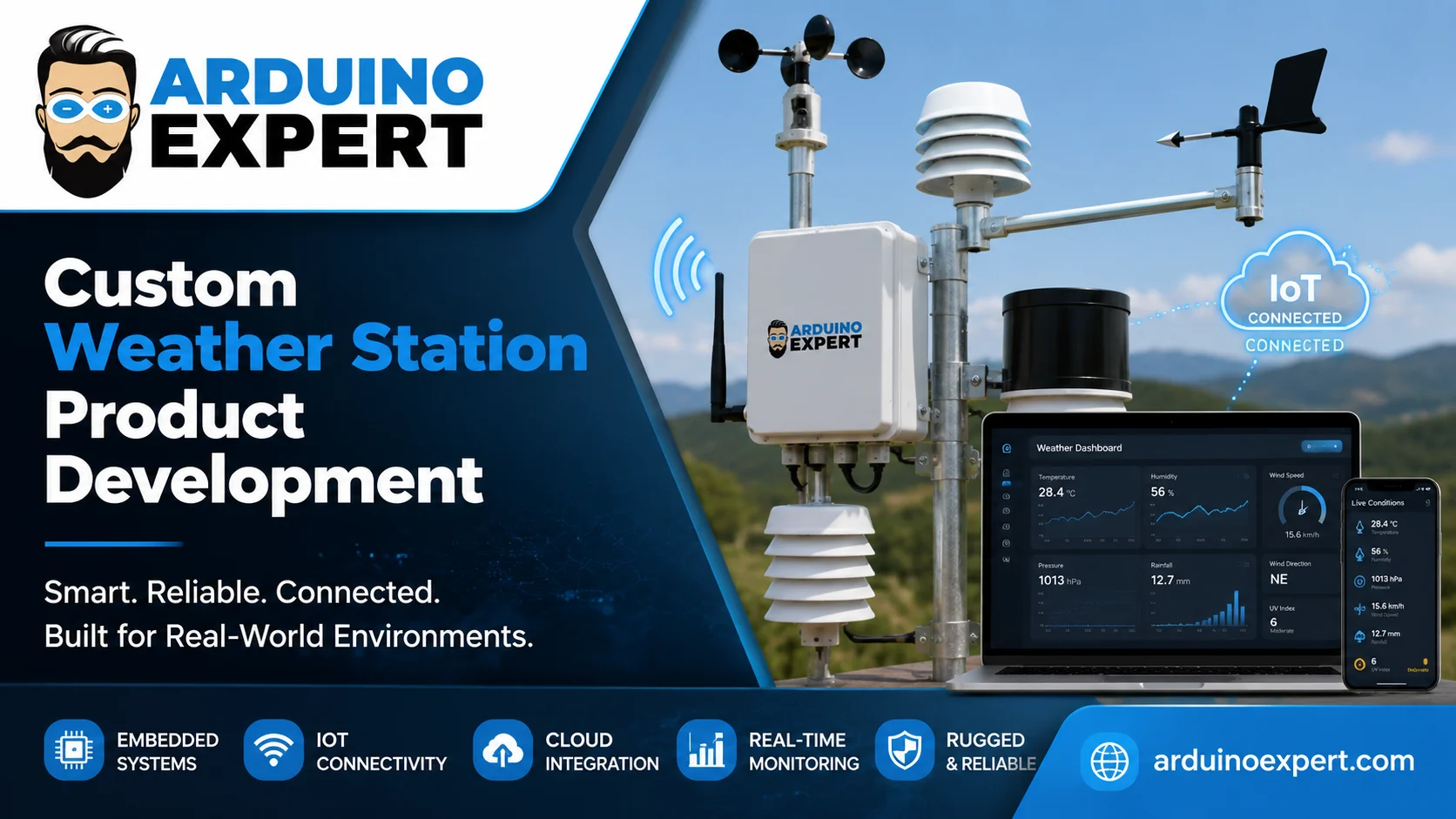
Different applications require different types of weather data.
A weather station designed for a greenhouse may need temperature, humidity, soil moisture and solar-radiation monitoring. A station installed at an industrial facility may require wind, rainfall, air-quality and remote-alert capabilities. A research station may require high-resolution data logging, configurable sampling intervals and access to raw sensor data.
We begin by understanding:
Based on these requirements, we create a customized weather station architecture that balances functionality, reliability, power consumption, communication range and development cost.
We integrate suitable sensors according to the environmental data your system needs to collect.
A custom weather station can include measurement of:
The exact sensor combination is selected according to your required measurement range, interface, response time, operating environment, maintenance requirements and target product cost.
We can work with digital, analogue, pulse-output, serial and industrial communication sensors
The embedded controller is the central part of a weather station. It collects sensor readings, performs calculations, stores data and manages communication with local or remote platforms.
Depending on the project requirements, we can develop the system using:
Controller selection depends on the number of sensors, communication interfaces, required processing capacity, power budget, operating conditions and production objectives.
For early prototypes, development boards can reduce development time. For a compact or commercially produced system, we can design a dedicated PCB containing the controller, communication interfaces, sensor connections, power-management circuits and protection components.
We develop the firmware required to operate the weather station and manage its complete data cycle.
Firmware capabilities may include:
The firmware can also calculate derived weather values such as dew point, heat index, rainfall rate or other application-specific indicators.
Development is structured around the required functionality and future scalability of the product.
Wi-Fi is suitable for homes, laboratories, greenhouses, offices, educational facilities and locations with dependable network coverage.
A Wi-Fi weather station can transmit readings directly to:
Cellular connectivity can be used for remote locations where Wi-Fi or wired internet is unavailable.
Depending on regional network availability and project requirements, cellular weather stations can provide:
LoRa communication is suitable when multiple weather stations or distributed environmental sensors must communicate over long distances with low power consumption.
A LoRa-based architecture may include:
Ethernet, RS-485 or other wired communication methods can be used for industrial sites, fixed installations and environments where stable wired communication is preferred.
The final communication method is selected after evaluating installation distance, infrastructure, power availability, data volume and operating environment.
Weather data becomes more useful when users can view trends, compare historical conditions and receive alerts from any location.
We can develop or integrate dashboards that display:
Dashboard access can be configured for administrators, operators, customers, researchers or other authorised users.
Depending on the project, data can be connected to an existing IoT platform or a custom web-based monitoring system.
A dedicated application can provide convenient access to live and historical weather information.
Possible application features include:
We can develop the weather station, embedded system and application as one connected product so that the hardware and software operate together reliably.
Not every application depends entirely on remote monitoring. A weather station can also include a local interface for users at the installation site.
Possible interfaces include:
The display can show live readings, connectivity status, warnings, battery level, date and time, or selected historical values.
The interface is designed according to the user environment and required level of interaction.
Weather stations are often installed in locations where internet connectivity may be unstable. The system should continue collecting data even when the network is temporarily unavailable.
We can include local storage through:
When connectivity returns, buffered records can be uploaded to the server where required.
Data-logging features may include:
This makes the system suitable for field research, agriculture, remote monitoring and long-term environmental studies.
The weather station’s power system is developed according to its installation environment and required operating time.
Available options can include:
For remote stations, we evaluate expected sensor consumption, communication frequency, controller operating modes and available sunlight before defining the solar panel and battery requirements.
Power-management capabilities may include:
The objective is to create a system that can operate consistently under the expected deployment conditions.
Outdoor weather stations require an enclosure and mounting structure designed for real environmental exposure.
Our mechanical-development capabilities can include:
Enclosure design considers the placement requirements of each sensor. Temperature and humidity sensors, for example, must be protected while remaining exposed to suitable airflow. Rain, wind and solar sensors must be positioned so that the enclosure does not interfere with their operation.
Prototype enclosures can be 3D printed for fit testing and field evaluation before selecting a final manufacturing process.
Our custom weather station development services can support applications such as:
The weather station can operate as an independent monitoring product or as part of a larger automation, IoT or decision-support system.
Whether you need a weather station for agriculture, research, industry, smart infrastructure or a new commercial product, Arduino Expert can help you develop a solution around your exact requirements.
Share your required weather parameters, installation environment, communication method and product goals with our team. We will review the requirements and propose a suitable development approach.
A custom weather station is a weather-monitoring system designed around specific sensors, communication methods, power sources, interfaces and installation requirements. Unlike a standard commercial unit, its hardware and software can be adapted to a particular application.
Yes. We can support the complete development process, including requirement analysis, sensor integration, electronics, firmware, PCB design, wireless communication, cloud dashboards, applications, enclosure design, prototyping and production preparation.
The station can be developed to measure temperature, humidity, pressure, rainfall, wind speed, wind direction, solar radiation, ultraviolet radiation, soil conditions, leaf wetness, air quality and other environmental parameters.
Yes. Remote operation can be supported through cellular or long-range communication, solar power, batteries, low-power firmware and local data storage
Yes. The weather station can continue recording data locally when internet connectivity is unavailable. Depending on the design, stored data can be uploaded automatically after communication is restored
Yes. Solar-powered and solar-battery weather stations can be developed according to expected energy consumption, communication frequency and installation conditions.
Yes. We can review an existing prototype or system and assist with sensor upgrades, firmware changes, communication improvements, dashboard integration, PCB development or enclosure redesign.
Yes. The system can be connected to a mobile application, responsive web dashboard or existing IoT platform for remote access.
Yes. Alerts can be generated for weather thresholds, low battery, sensor faults, communication loss and other defined conditions.
Yes. Weather-station data can be integrated with irrigation controllers to adjust watering according to rainfall, temperature, humidity, wind, soil conditions or other defined logic.
Yes. A dedicated PCB can be developed after the system requirements and prototype architecture have been validated.
Yes. We provide custom enclosure, sensor mounting, bracket design and prototype 3D-printing support.
Yes. We can assist with product architecture, prototype iterations, PCB design, enclosure development, bill of materials and production-preparation files.
The cost depends on the number and type of sensors, required measurement performance, communication method, power system, dashboard, application, enclosure and production requirements. After reviewing your project specification, we can provide a customised development estimate. Contact us for more information.
We are a dynamic team of experts from diverse Engineering Disciplines. Our expertise spans from simple Arduino projects to complex product design and development, offering end-to-end solutions tailored to meet our clients’ unique needs. From the initial research phase to Final Product, ensuring a seamless journey from concept to market-ready solutions.