
A smart water tank monitoring system continuously measures the available water level and displays the information through a mobile app, web dashboard, local display, or control panel.
ArduinoExpert develops custom smart water tank monitoring and pump automation systems with real-time level tracking, mobile alerts, automatic pump control, and Wi-Fi, GSM or LoRa connectivity.
The system can also automatically start and stop the pump according to selected water-level thresholds.
For example:
Each system is customized according to the number of tanks, tank dimensions, pump type, installation environment, communication range, and required control features.
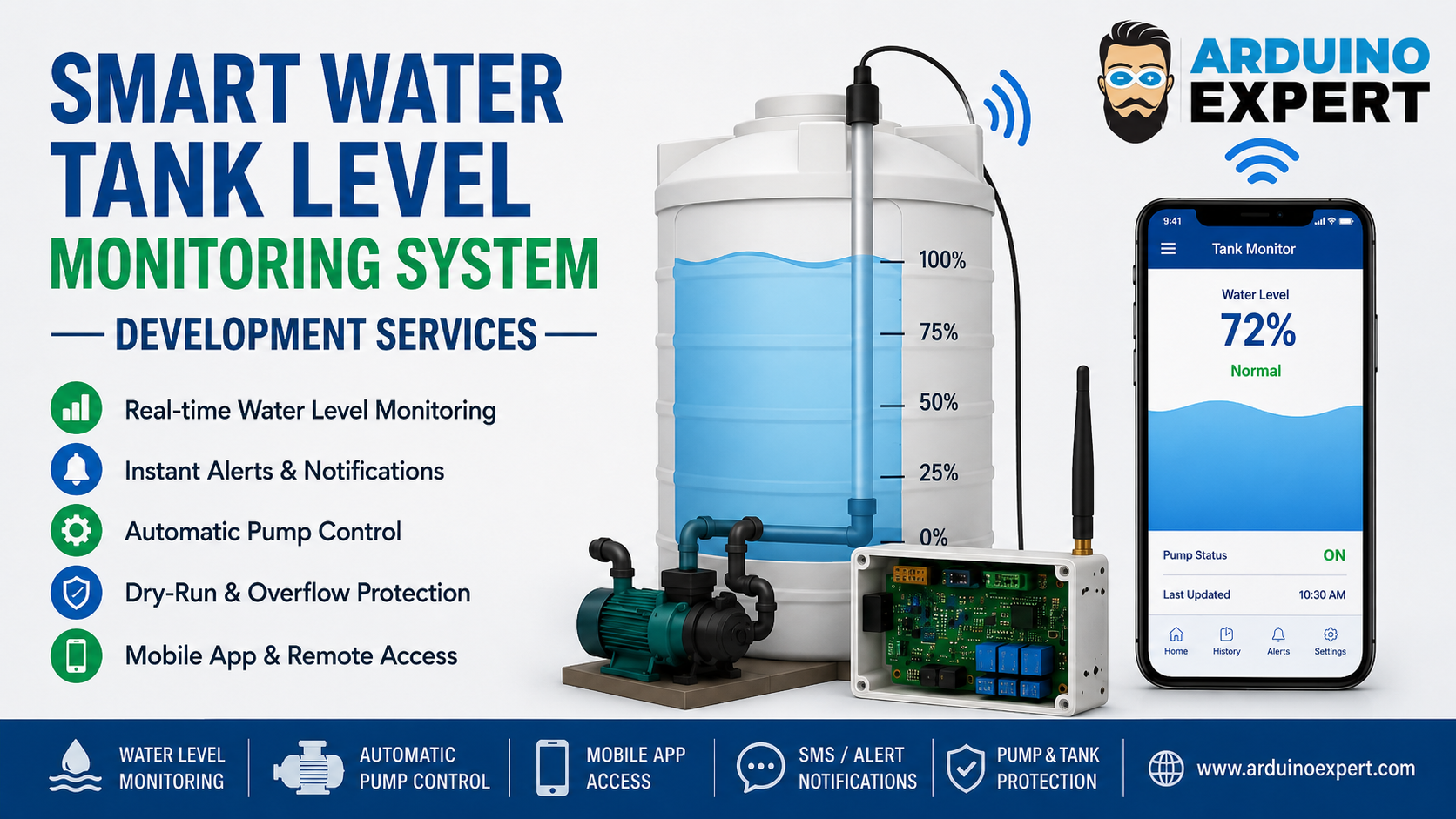
Manually checking a water tank is inconvenient and can result in overflowing tanks, unexpected water shortages, unnecessary pump operation, and damaged pumping equipment.
A smart water tank monitoring system continuously measures the available water level and displays the information through a mobile app, web dashboard, local display, or control panel.
The system can also automatically start and stop the pump according to selected water-level thresholds.
For example:
Each system is customized according to the number of tanks, tank dimensions, pump type, installation environment, communication range, and required control features.
A smart water tank level monitoring system is an electronic solution that measures the amount of water inside a storage tank and communicates the information to the user or an automated control system.
Depending on your project scope, the system may provide:
We can develop a basic monitoring device or a complete IoT water-management platform.
Reliable water-level monitoring begins with selecting the correct sensor.
We evaluate the tank depth, shape, material, installation location, environmental conditions, required accuracy, and project budget before recommending a sensing method.
Sensor options may include:
A backup float switch can also be added as an independent safety mechanism for overflow or low-water protection.
We develop the embedded software that controls the complete monitoring and automation process.
The firmware can manage:
The system logic is developed according to the actual behavior required for your tanks and pumps.
The monitoring system can automatically operate a water pump, transfer pump, tubewell pump, or valve.
Available control functions may include:
Local automation can continue even when mobile, cloud, or internet connectivity is interrupted.
We can develop or integrate an interface that allows users to monitor and control the system remotely.
The mobile app or dashboard may show:
Depending on the project, the system can use Blynk, Firebase, ThingsBoard, MQTT, a custom cloud platform, or a completely customized mobile and web application.
For permanent installations and commercial products, we can convert the initial circuit into a custom printed circuit board.
The PCB may include:
We can also develop a working prototype, assist with enclosure planning, and prepare manufacturing files for future production.
Different tanks require different sensing technologies. We select the sensor according to the actual operating conditions rather than using one sensor for every project.
Ultrasonic sensors measure the distance between the sensor and the water surface without physically touching the water.
They are commonly suitable for:
They provide non-contact measurement and are relatively easy to install.
Hydrostatic sensors measure water pressure to calculate the water depth.
They may be suitable for:
These sensors can provide stable measurements where ultrasonic sensing may be affected by the installation environment.
Float switches provide simple and reliable point-level detection.
They can be used for:
Float switches are often used as an additional safety mechanism even when a continuous level sensor is installed.
Capacitive sensors can detect liquid levels through certain non-metallic tank walls or through direct-contact sensing configurations.
They can be useful in compact or specialized applications where mechanical floats are not suitable.
Radar sensors provide non-contact level measurement and can perform reliably in more demanding environments.
They may be suitable for:
Conductive probes provide a cost-effective method for detecting water at different predefined levels.
They may be appropriate for simple water-level indication and basic pump automation systems.
Wi-Fi is suitable for homes, offices, buildings, and facilities with reliable internet coverage.
It allows real-time monitoring through a mobile app or cloud dashboard.
GSM or cellular communication is suitable for remote areas where Wi-Fi is unavailable.
The system can provide:
This option is useful for farms, tube wells, remote storage tanks, and agricultural sites.
LoRa communication is suitable for transmitting tank data over longer distances while consuming relatively low power.
It can be used for:
Bluetooth may be used for local configuration, short-range monitoring, or systems that do not require cloud connectivity.
For industrial systems, we can integrate tank-level data with PLCs, SCADA systems, building-management systems, and existing control panels through RS485 or Modbus communication.
The system can also operate without internet connectivity through:
Internet connectivity can be added only for remote monitoring while essential control remains available locally.
A residential system can monitor underground and overhead water tanks while automatically managing the transfer pump.
Homeowners can receive notifications when:
Apartment buildings, hotels, hospitals, schools, offices, and shopping centers may require centralized monitoring of several tanks and pumps.
A custom dashboard can help facility managers:
For farms and remote sites, we can connect tanks, reservoirs, tubewells, pumps, and irrigation systems.
Available features may include:
Industrial systems may include:
ArduinoExpert has developed AabNex SMS, a commercial controller designed for compatible solar tubewell VFD systems.
AabNex SMS allows farmers and operators to start, stop, monitor, and protect a solar tubewell through SMS. It also supports local button control and a built-in hotspot webpage for nearby access without internet connectivity.
Its capabilities include:
This product demonstrates our practical experience in GSM communication, VFD integration, pump protection, embedded firmware, and commercial agricultural automation.
We review the tank dimensions, number of tanks, pump details, installation environment, connectivity, and required features.
We select the sensor, controller, communication method, pump-control hardware, power system, and protection features.
We develop the circuit, embedded firmware, pump-control logic, communication, and alerts.
We create or integrate the required mobile application, web dashboard, or cloud platform.
We test sensor accuracy, pump automation, connectivity, alerts, power interruptions, and fault conditions.
When required, we develop a custom PCB, prepare manufacturing files, and provide the agreed technical documentation.
Depending on the agreed scope, your project may include:
We can handle sensors, electronics, firmware, wireless communication, pump control, dashboards, PCB development, and prototype assembly.
Your system is designed according to your actual tanks, pumps, connectivity, and operating requirements.
Our experience includes ESP32 water tank automation, NodeMCU monitoring systems, IoT water pump control, GSM tubewell control, smart irrigation, and the commercial AabNex SMS controller.
We can work with Wi-Fi, GSM, 4G, LoRa, Bluetooth, MQTT, RS485, Modbus, and cloud platforms.
We can support concept validation, prototype development, custom PCB design, enclosure planning, testing, and manufacturing preparation.
Explore some of our related water monitoring, pump control, and agricultural automation projects.
Whether you need a simple household tank monitor, an automatic underground-to-overhead transfer system, a remote agricultural solution, or a market-ready IoT water-management product, ArduinoExpert can develop the complete solution.
Share your tank dimensions, pump details, number of tanks and required connectivity. We will review your requirements and recommend a suitable monitoring and automation solution.
It is an electronic system that measures the amount of water inside a tank and displays the information through a mobile app, dashboard, local screen, or control panel. It may also automatically control pumps and valves.
Yes. The system can send the current water level to a mobile application through Wi-Fi, GSM, 4G, or another suitable communication technology.
Yes. The system can monitor both tanks and operate the transfer pump only when sufficient water is available in the source tank.
Yes. The pump can start when the tank level becomes low and stop automatically when the selected upper limit is reached.
The most suitable sensor depends on the tank depth, shape, material, installation environment, required accuracy, and budget. Waterproof ultrasonic, pressure, float, capacitive, and radar sensors are among the available options.
Yes. The system can use GSM, 4G, LoRa, Bluetooth, or local offline controls. Essential pump automation can also operate directly on the local controller without internet access.
Yes. We can develop a centralized dashboard for multiple tanks, pumps, and locations.
Yes. Dry-run protection can use tank sensors, flow sensors, pressure sensing, electrical current monitoring, or VFD feedback.
Yes. We can develop an integrated system that combines tank-level monitoring with solar tubewell or VFD pump control.
Yes. We can support hardware, firmware, custom PCB design, mobile or web applications, prototype testing, enclosure planning, and manufacturing documentation.
Yes. Depending on the existing equipment, it can be integrated with relays, contactors, VFDs, PLCs, and control-panel circuits.
The cost depends on the number of tanks, sensor type, pump-control requirements, connectivity, dashboard functionality, PCB development, and prototype requirements.
We are a dynamic team of experts from diverse Engineering Disciplines. Our expertise spans from simple Arduino projects to complex product design and development, offering end-to-end solutions tailored to meet our clients’ unique needs. From the initial research phase to Final Product, ensuring a seamless journey from concept to market-ready solutions.