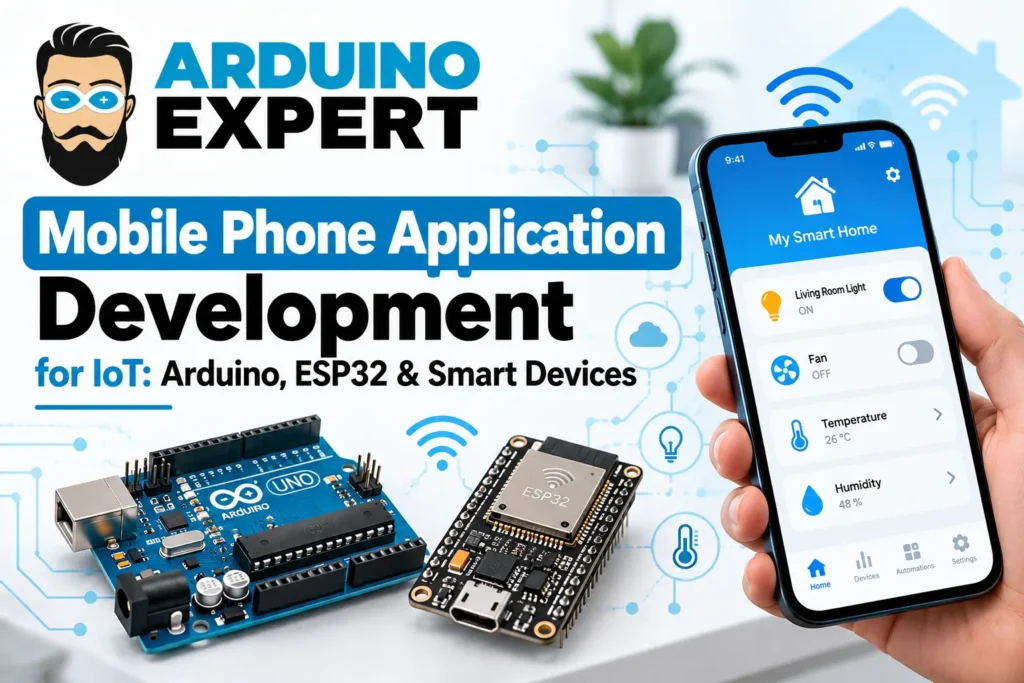
Smartphones are no longer just communication devices. They have become powerful tools for monitoring, controlling, and managing intelligent electronic systems. From smart home automation and industrial monitoring to wireless sensors and connected consumer products, mobile phone application development for IoT is transforming how people interact with technology.
Imagine controlling an ESP32-based device through your smartphone, checking live sensor readings from anywhere in the world, or receiving instant notifications when a smart system detects an issue. These capabilities are made possible by combining mobile application development, embedded systems, wireless communication, and cloud technology.
At Arduino Expert, we specialize in custom mobile app development for IoT devices, Arduino, ESP32, embedded systems, and smart hardware products. Our services connect physical electronics with user-friendly Android and iOS applications, helping businesses, engineers, startups, and product developers turn innovative ideas into functional connected solutions.
In this guide, we explore how IoT mobile apps work, which technologies are used, how mobile applications communicate with Arduino and ESP32 devices, the development process, project costs, and real examples of smart devices connected to mobile applications.
What Is Mobile Phone Application Development for IoT?
Mobile phone application development is the process of designing, developing, testing, and deploying software applications for smartphones and tablets, primarily using Android and iOS operating systems.
Traditional mobile applications focus on functions such as messaging, shopping, entertainment, or business management. IoT mobile applications go a step further by connecting smartphones with physical electronic devices.
An IoT mobile app allows users to monitor, manage, and control connected hardware using technologies such as Bluetooth, Wi-Fi, MQTT, HTTP APIs, and cloud platforms.
For example, an ESP32-based temperature monitoring system can collect readings from a sensor and transmit them to a mobile application. Users can view real-time temperature data, analyze trends, configure alerts, and remotely control connected equipment.
A typical IoT solution consists of four important elements:
- Hardware: Arduino, ESP32, ESP8266, Raspberry Pi, or custom microcontroller-based electronics.
- Embedded firmware: Software running on the device to manage sensors, actuators, and communication.
- Connectivity: Bluetooth Low Energy (BLE), Wi-Fi, MQTT, HTTP, or other appropriate communication methods.
- Mobile application: An Android or iOS app that provides dashboards, controls, notifications, and device management.
Depending on the requirements, an IoT system may also include cloud infrastructure for remote access, data storage, authentication, and analytics.
By combining these technologies, developers can create connected products for smart homes, agriculture, healthcare, industrial automation, energy management, and consumer electronics.
Why Mobile App Development Is Important for IoT and Smart Devices
A smart electronic device becomes considerably more useful when users can interact with it through a convenient mobile interface.
Instead of relying entirely on physical switches, small displays, or direct computer connections, a mobile application can provide an accessible control center.
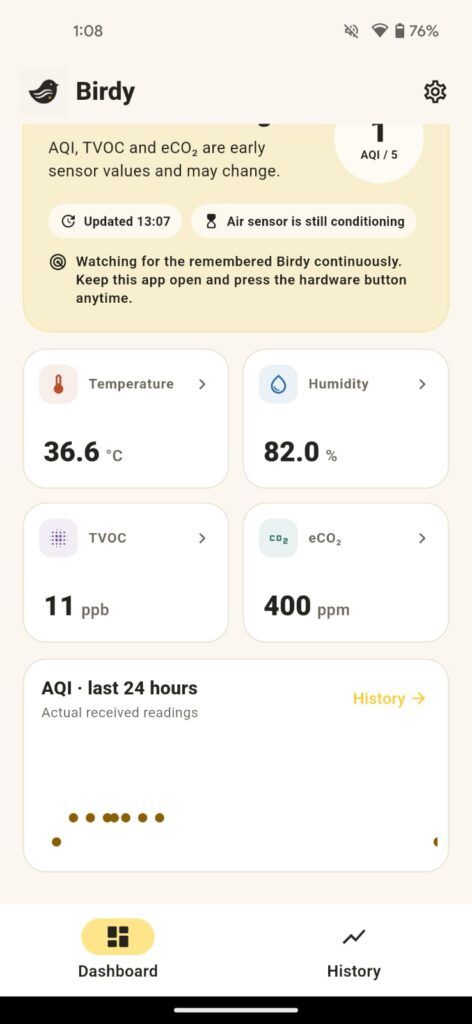
1. Real-Time Device Monitoring
IoT mobile applications can display live sensor readings, including temperature, humidity, pressure, air quality, water level, energy consumption, and equipment operating status.
For example, an ESP32-based environmental monitoring system can transmit readings to a smartphone dashboard. Users can quickly identify unusual conditions without manually checking the device.
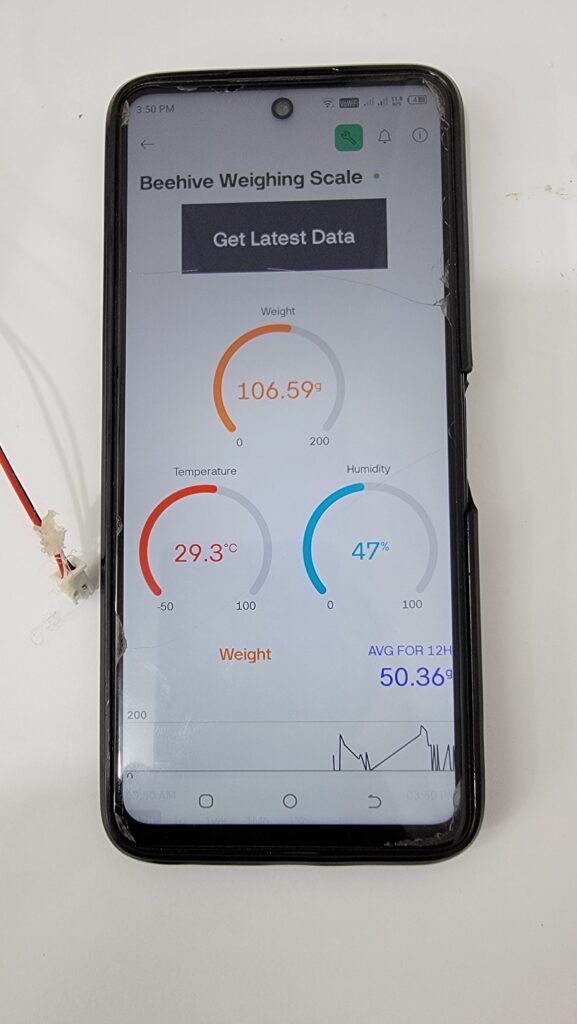
2. Wireless Device Control
A mobile app can send commands to compatible electronic hardware through Bluetooth or Wi-Fi.
Common examples include controlling lights, adjusting motor speeds, changing operating modes, configuring irrigation schedules, and managing smart appliances.
3. Remote Access and Automation
When connected through an appropriate internet-enabled architecture, IoT applications can provide access to devices beyond the local network.
Users may monitor connected equipment, receive cloud-generated alerts, or update settings while away from the installation location.
Remote access requires a suitable gateway, server, or cloud connection. Bluetooth-only systems generally provide local, short-range control.
4. Better User Experience
Well-designed mobile applications simplify complex hardware functions through visual controls, charts, device status indicators, and intuitive navigation.
A user does not need to understand microcontroller programming to operate a properly designed smart device.
5. Data Collection and Analytics
Connected applications can store sensor readings and operational events for later analysis.
Historical dashboards can help identify patterns, evaluate system performance, and support maintenance decisions.
For commercial products, this information can also help manufacturers understand how their connected devices are being used, subject to appropriate privacy safeguards.
Arduino and ESP32 in Mobile Application Development
Arduino and ESP32 are widely used in electronics prototyping, IoT systems, automation, and connected product development.
Both platforms can form the hardware foundation of a mobile-controlled system, but they have different capabilities.
Arduino Mobile App Development
Arduino is a flexible electronics development platform used for sensor interfacing, actuator control, embedded programming, and rapid prototyping.
Arduino mobile app development makes it possible to create smartphone interfaces that communicate with Arduino-based hardware.
Depending on the board and additional communication modules, Arduino projects can support:
- Bluetooth-based device control.
- Wi-Fi-connected sensor monitoring.
- Smart irrigation and automation applications.
- Wireless robotics and motor control.
- Mobile-controlled lighting and relay systems.
- Data logging and environmental monitoring.
For example, an Arduino-based water tank system can use a wireless communication module to send water-level readings to a smartphone and receive pump-control commands.
Not all Arduino boards include built-in wireless connectivity. Some require compatible Wi-Fi, Bluetooth, or cellular modules.
Explore our Arduino Project Development Services for custom Arduino programming, hardware integration, and automation solutions.
ESP32 Mobile App Development
The ESP32 family is particularly suitable for connected devices because many models include built-in Wi-Fi and Bluetooth Low Energy capabilities.
ESP32 mobile app development enables wireless communication between a microcontroller and a smartphone without requiring a separate connectivity module in many designs.
ESP32 applications are commonly used for:
- Bluetooth-connected consumer electronics.
- Smart home control and automation.
- Wi-Fi-based sensor dashboards.
- IoT energy monitoring.
- Smart agriculture and irrigation.
- Wireless robotics.
- Connected environmental sensors.
- Industrial monitoring and control.
A mobile application can receive readings from an ESP32, display real-time information, and transmit commands to control actuators or change device settings.
It is important to select the correct ESP32 variant. For example, the original ESP32 supports Bluetooth Classic and BLE, while several newer variants, including ESP32-C3 and ESP32-S3, support BLE but not Bluetooth Classic.
At Arduino Expert, we provide ESP32 Project Development Services covering firmware development, sensor integration, wireless connectivity, embedded hardware, and IoT solutions.
You can also read our Complete Guide to Custom ESP32 Project Development to understand ESP32 applications and professional development services.
How Do Mobile Apps Communicate with Arduino and ESP32?
One of the most important aspects of IoT mobile application development is selecting the communication technology.
The right protocol depends on the hardware, operating range, power requirements, security needs, and whether users need local or remote access.
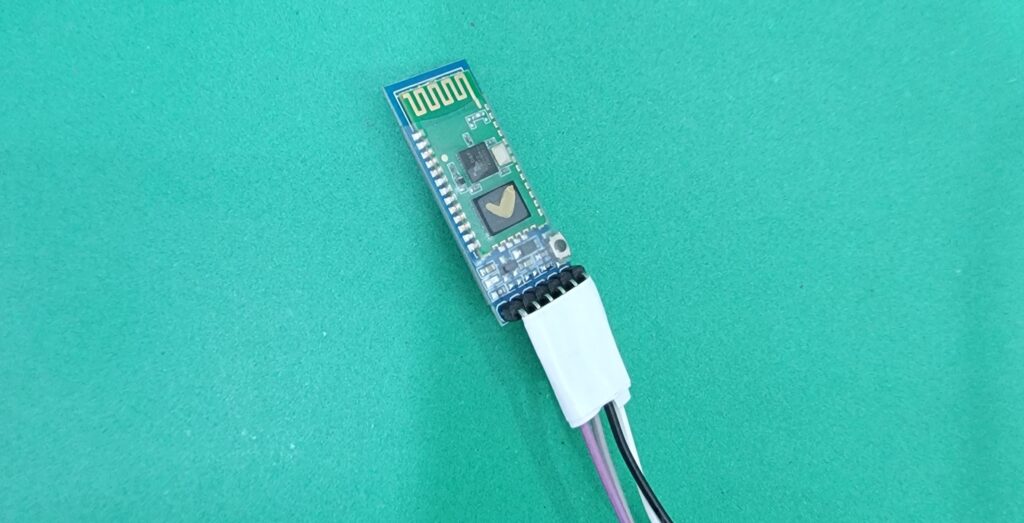
Bluetooth and Bluetooth Low Energy App Development
Bluetooth is suitable for applications where the smartphone communicates directly with a nearby device.
Bluetooth Low Energy (BLE) is particularly useful for battery-powered sensors, wearable electronics, environmental monitoring devices, and compact smart products.
A BLE mobile application typically connects to a peripheral device, reads or writes characteristics, and exchanges information through defined services.
Common BLE mobile app features include device discovery, secure pairing or bonding when appropriate, sensor data monitoring, command transmission, and connection management.
Bluetooth Classic may also be suitable for certain Android-connected devices. However, generic serial Bluetooth Classic approaches are not automatically compatible with iOS. BLE is often the more practical choice when supporting both Android and iOS.
Wi-Fi Mobile App Development
Wi-Fi mobile app development for ESP32 is useful when a device needs local network access, higher data throughput, or internet connectivity.
An ESP32 can communicate over a local network or connect to a backend service through an internet-enabled router.
Common applications include smart appliances, energy meters, irrigation controllers, industrial dashboards, and connected home systems.
A Wi-Fi-enabled system may use HTTP requests, WebSockets, MQTT, or a cloud platform to exchange information with a mobile application.

MQTT Mobile App Development
MQTT is a lightweight publish-subscribe messaging protocol commonly used in IoT systems.
In an MQTT-based architecture, devices and applications communicate through a message broker.
For example, an ESP32 can publish sensor information to an MQTT topic. A backend or authorized mobile application can subscribe to relevant messages and display updated readings.
Similarly, control commands can be delivered through appropriate MQTT topics.
MQTT can be effective for systems with multiple devices, cloud-connected dashboards, and remote monitoring requirements.
Production implementations should use suitable authentication, encrypted transport, access controls, and device-specific permissions.
Choosing the Right Communication Technology
| Technology | Typical application | Internet required? |
|---|---|---|
| Bluetooth Classic | Compatible local device control, including certain Android applications | No |
| Bluetooth Low Energy | Wireless sensors, wearables, battery-powered devices | No |
| Local Wi-Fi | Device monitoring and control on the same network | No |
| MQTT with cloud broker | Cloud messaging and remote device monitoring | Yes |
| HTTP / REST APIs | Backend integration and cloud-connected apps | For remote cloud access |
| WebSockets | Live dashboards and bidirectional communication | Depends on architecture |
For devices that must continue operating during internet outages, local control and offline functionality should be considered early in the design process.
Key Features of a Custom IoT Mobile Application
A successful smart device application requires more than an attractive interface. It should also deliver dependable communication, useful controls, and understandable feedback.
Real-Time IoT Dashboard
An IoT dashboard presents sensor readings, operating conditions, device status, and important events in a clear format.
It may include live graphs, gauges, status indicators, device cards, and historical trend charts.
Device Discovery and Connection Management
Bluetooth-enabled applications should make device discovery, connection, disconnection, and reconnection straightforward.
For Wi-Fi systems, the application may also support device onboarding, network configuration, and connection status monitoring.
Remote Monitoring and Control
Where remote access is supported, authorized users can monitor devices and send commands through a secure backend.
Examples include adjusting equipment settings, enabling operating modes, controlling pumps, and managing smart appliances.
Notifications and Alerts
Applications may notify users about temperature thresholds, unusual sensor readings, equipment faults, low battery levels, or connectivity changes.
The alert mechanism depends on the system architecture. Local alerts, cloud push notifications, and critical safety mechanisms have different requirements.
Scheduling and Automation
Automation features allow users to configure operating schedules or device behavior.
For example, a mobile application may configure a pet feeder’s daily feeding times or an irrigation system’s watering schedule.
Where reliability matters, critical schedules should ideally be stored and executed on the device or a dependable local controller rather than relying on the mobile application remaining open.
Device Settings and Firmware Updates
Connected products may require configuration tools, calibration controls, diagnostic information, and firmware update capabilities.
For supported devices, over-the-air (OTA) firmware updates can simplify maintenance without physically connecting the hardware to a development computer.
Security and User Authentication
Commercial IoT mobile applications should implement suitable protections such as encrypted communications, secure credentials, user authentication, device authorization, and appropriate data access controls.
For products with multiple users or connected devices, permissions and device ownership management become especially important.
Step-by-Step Mobile App Development Process for IoT Devices
Developing an IoT mobile application involves close coordination between mobile software, embedded firmware, electronics, and backend development.
At Arduino Expert, our custom mobile app development services cover Android and iOS applications, embedded device integration, dashboards, cloud connectivity, testing, and deployment.
A typical development workflow follows these stages.
Step 1: Define the Project Requirements
The first step is understanding what the connected product should accomplish.
Important questions include:
- Which hardware platform will be used?
- What information must appear in the app?
- Does the device need Bluetooth, Wi-Fi, or cloud connectivity?
- Is the application for Android, iOS, or both?
- How many devices and users must the system support?
- Should the product work without internet access?
- What level of security and reliability is required?
Clear requirements help avoid expensive redesigns during development.
Step 2: Select the Hardware and Communication Architecture
The development team selects suitable hardware, sensors, communication interfaces, and system architecture.
An Arduino-based device might require an additional wireless communication module, while an ESP32 may provide the necessary connectivity through its integrated radio.
The architecture should also define whether communication is direct, cloud-based, or a combination of both.
Step 3: Design the Mobile App UI/UX
UI/UX design focuses on creating an intuitive interface for the intended users.
Typical screens include a home dashboard, device connection page, sensor monitoring panel, control interface, settings menu, and notification center.
Wireframes and prototypes help validate the user experience before full software development.
Step 4: Develop Embedded Firmware
Firmware handles the hardware functions required for mobile communication.
This may involve reading sensors, controlling outputs, processing commands, configuring wireless interfaces, and managing error conditions.
For ESP32 development, the firmware may be implemented using the Arduino framework or Espressif’s ESP-IDF, depending on project requirements.
Step 5: Build the Android or iOS Application
The mobile application is developed using the selected technology.
For example, Flutter can support Android and iOS applications from a shared codebase, while native development may be preferred where specific platform capabilities or performance requirements justify it.
The development team implements the dashboards, user interactions, device communication logic, data storage, and required backend integrations.
Step 6: Integrate the Mobile App with the Hardware
This is one of the most important stages in embedded mobile app development.
The application must exchange data and commands reliably with the physical device.
Integration testing checks device discovery, communication protocols, sensor values, command handling, reconnection behavior, and system responses.
Step 7: Test Security, Performance, and Reliability
IoT applications should be tested with real hardware, not only software simulators.
Important scenarios include wireless disconnections, incorrect commands, power interruptions, unexpected device restarts, poor connectivity, and operating system permission changes.
Testing should also verify that critical functions remain safe if the mobile app or network becomes unavailable.
Step 8: Deployment, Maintenance, and Support
After successful testing, the application can be prepared for distribution through the appropriate platform or private deployment channel.
Ongoing development may include firmware updates, bug fixes, security patches, additional features, and compatibility improvements.
For commercial smart devices, long-term maintenance planning should be part of the original product strategy.
Technologies Used for Android, iOS, and IoT App Development
Different technologies serve different roles in a connected product.
| Technology | Purpose |
|---|---|
| Flutter | Cross-platform Android and iOS development |
| React Native | Cross-platform mobile applications |
| Kotlin | Native Android app development |
| Swift | Native iOS app development |
| Firebase | Authentication, databases, and cloud services |
| AWS / Azure | Cloud infrastructure and IoT backend services |
| MQTT | Device messaging and data exchange |
| HTTP / REST APIs | App-to-backend communication |
| WebSockets | Bidirectional real-time updates |
| ESP-IDF / Arduino framework | ESP32 firmware development |
Choosing the right technology depends on the product’s hardware, device connectivity, business requirements, and expected scale.
For example, an Android-only Bluetooth Classic controller may have different requirements from a commercial BLE product intended for both Android and iOS.
Similarly, a simple local device controller may not need the same backend infrastructure as an industrial monitoring platform managing hundreds of devices.
Real IoT and Mobile App Development Projects by Arduino Expert
At Arduino Expert, we work on connected products that combine microcontrollers, embedded software, electronic hardware, and mobile interfaces.
The following projects illustrate different ways mobile applications can interact with physical devices.
1. ESP32 Smart Bluetooth Pet Feeder with Custom Android App
One example is our Smart Bluetooth Pet Feeder with Custom App Control and OLED Using ESP32.
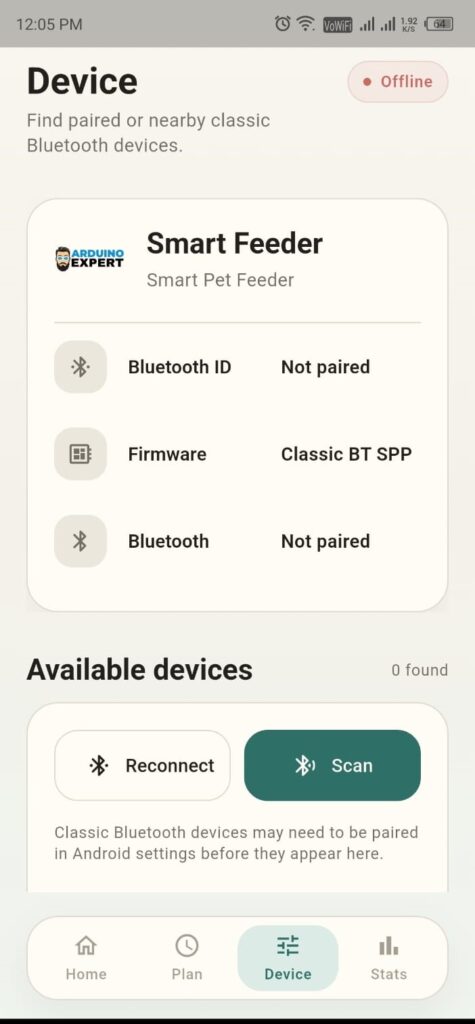
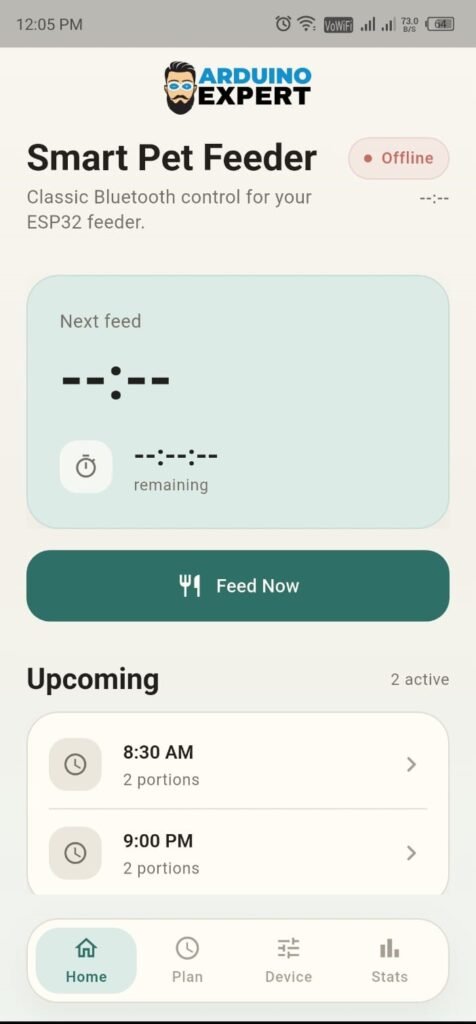
This project combines an ESP32 controller, a dedicated Android application, Bluetooth Classic communication, a real-time clock, a servo-operated feeding mechanism, and an OLED display.
The mobile application provides convenient controls for:
- Connecting to the ESP32 pet feeder.
- Dispensing food manually.
- Setting automatic feeding schedules.
- Configuring portion sizes.
- Viewing feeding information and history.
- Checking device connection status.
The pet feeder communicates directly with the Android application using Bluetooth Classic, without requiring an internet connection or cloud server.
An important design feature is that schedules are maintained by the ESP32, allowing scheduled feeding to continue when the smartphone is disconnected.
This project demonstrates custom Android app development for ESP32, local wireless control, firmware integration, and smart consumer product development.
2. Birdy — ESP32 Smart Air Quality Monitor with BLE Mobile App
Another example is Birdy, our ESP32 Smart Indoor Air Quality Monitoring Device.
Birdy combines environmental sensing, embedded electronics, wireless communication, and a custom mobile application.
The ESP32 communicates with the mobile app using Bluetooth Low Energy.
The application enables users to monitor environmental information such as temperature, humidity, total volatile organic compounds (TVOC), estimated CO₂ (eCO₂), and air-quality indicators.
It also provides historical data visualization, helping users understand changes in indoor environmental conditions over time.
This project illustrates how BLE mobile app development can transform an embedded sensor system into a more accessible smart product.
It is particularly relevant to smart home technology, environmental monitoring, and connected sensor product development.
3. ESP32 Smart Home Automation with Blynk Mobile App
Our ESP32-Based Smart Home Automation System Using Blynk IoT demonstrates how an ESP32 can communicate with an established IoT application platform.
The system integrates environmental sensors, motion detection, water-level monitoring, relay-controlled appliances, and a local display.
Using the Blynk mobile application, users can monitor sensor readings, control connected equipment, and switch between automatic and manual operating modes.
Unlike the pet feeder and Birdy projects, this example uses an existing IoT platform rather than a fully bespoke mobile app.
It demonstrates an alternative development approach for projects where a configurable platform can meet the requirements without building every app feature from scratch.
For businesses that require unique branding, specialized workflows, or proprietary device management, a custom mobile application may provide greater flexibility.
4. ESP32 Vehicle Control and Security with Mobile Interface
Our ESP32 Car Control System with Fingerprint and Mobile App is another example of mobile-connected electronics.
The system combines an ESP32 microcontroller, fingerprint authentication, wireless relay control, and a smartphone-based interface using RemoteXY.
The ESP32 operates in Wi-Fi access point mode, allowing a nearby smartphone to communicate with the controller without an internet connection.
The project demonstrates how mobile interfaces can be integrated with embedded controllers, biometric authentication, and electronic switching systems.
Safety-critical automotive applications require additional safeguards, validation, and compliance considerations before any real-world commercial deployment.
Together, these projects show that mobile-connected hardware can be developed using custom Android apps, BLE interfaces, local Wi-Fi controls, or third-party IoT platforms depending on the product’s needs.
Explore more examples in our IoT Projects Portfolio and ESP32 Projects Portfolio.
Applications of Mobile App Development for IoT and Smart Devices
Custom mobile applications can support a wide range of smart products and industrial systems.
Smart Home Automation
Smart home mobile apps can control lighting, appliances, environmental monitoring devices, smart locks, and energy management systems.
Depending on the product, they can support local wireless control, cloud connectivity, automation schedules, and remote alerts.
Industrial IoT Monitoring
Industrial IoT applications can display machine status, sensor readings, equipment alerts, operating trends, and maintenance information.
For industrial environments, mobile monitoring should be designed alongside appropriate safety systems, access controls, and reliable local automation.
Smart Agriculture and Irrigation
Agricultural IoT apps can support soil moisture monitoring, automated irrigation, greenhouse environment tracking, and pump management.
For example, a connected irrigation controller can collect environmental readings and use predefined rules to operate equipment while providing monitoring access through a mobile application.
Healthcare and Wellness Devices
Connected wellness products may use mobile applications to display measurements, device status, reminders, and historical information.
Applications that make medical claims or support clinical decisions require additional attention to validation, data protection, and applicable regulations.
Smart Consumer Electronics
Custom mobile applications are useful for smart pet feeders, connected toys, environmental monitors, fitness equipment, lighting products, and other electronic consumer devices.
These applications can improve usability while providing manufacturers with a branded interface for their hardware.
Robotics and Automation
Mobile apps can serve as wireless control panels for robots, actuators, and automation equipment.
Typical functions include selecting operating modes, monitoring telemetry, adjusting settings, and sending movement commands.
Control systems should include appropriate safeguards so that unsafe operations are not caused by connection failures or unintended commands.
How Much Does IoT Mobile App Development Cost?
The cost of mobile phone application development for IoT depends on the software requirements, hardware complexity, communication protocols, and project scope.
A simple Bluetooth controller typically requires fewer development components than a commercial IoT platform with cloud services, multiple user accounts, extensive analytics, and fleet management.
Major cost factors include:
1. App complexity: A basic device-control interface is generally less complex than a multi-screen application with advanced analytics and account management.
2. Mobile platforms: Developing for Android only may require a different level of effort from supporting Android and iOS with platform-specific hardware features.
3. Hardware integration: Custom communication protocols, firmware changes, sensor calibration, and hardware debugging can add development effort.
4. Connectivity: Local Bluetooth communication may avoid the backend requirements of a remote cloud-connected system.
5. Cloud infrastructure: Authentication, databases, real-time messaging, device management, hosting, and monitoring introduce additional implementation and operating costs.
6. Security and reliability: Secure onboarding, encrypted communication, user permissions, recovery handling, and rigorous testing are essential considerations for commercial products.
7. Long-term maintenance: Operating system updates, firmware compatibility, application updates, hosting, and technical support affect the product’s lifetime cost.
Custom IoT App or Existing IoT Platform?
For prototypes and smaller projects, existing IoT platforms such as Blynk can be an efficient starting point.
A custom application may be more suitable when a business needs:
- A unique branded mobile interface.
- Custom device communication protocols.
- Specialized controls and automation workflows.
- Integration with proprietary cloud services.
- Advanced user and device management.
- Greater control over product features and future development.
The best approach is to define the minimum viable product (MVP), confirm the communication architecture, and estimate the required development effort before expanding the feature set.
If you are planning an IoT-enabled product, contact Arduino Expert to discuss the hardware, app requirements, and an appropriate development scope.
Common Challenges in Arduino and ESP32 Mobile App Development
Building an application that interacts with real hardware introduces challenges not always found in traditional mobile software.
Unstable Wireless Connections
Bluetooth or Wi-Fi connections may be interrupted by distance, interference, device power states, or network changes.
A well-designed application should manage disconnections, display accurate connection status, and attempt recovery where appropriate.
Hardware and Firmware Compatibility
Mobile applications depend on the device’s communication protocol and firmware behavior.
Changes to firmware commands, data formats, or supported features may require corresponding changes to the application.
Version compatibility should therefore be considered during development.
Android and iOS Differences
Mobile operating systems have different hardware permissions, Bluetooth capabilities, background execution policies, and distribution requirements.
These differences are important when creating cross-platform IoT applications.
Power Consumption
Battery-powered smart devices require careful power optimization.
Wireless communication frequency, sensor activity, firmware behavior, and connection management can significantly affect battery life.
Security and Privacy
Connected products can expose sensitive device functions or user data if authentication and communication security are poorly designed.
Security should be planned across hardware, firmware, mobile applications, and cloud infrastructure rather than added only at the end.
Scaling from Prototype to Commercial Product
A working prototype is an important achievement, but commercial deployment introduces further requirements such as manufacturing consistency, device provisioning, remote updates, fault recovery, documentation, support, and long-term maintainability.
Combining hardware and software expertise early in development can reduce many of these integration challenges.
Why Choose Arduino Expert for Custom IoT Mobile App Development?
Developing a mobile application for an IoT product requires an understanding of both the smartphone interface and the electronics behind it.
At Arduino Expert, our work combines mobile app development, microcontroller programming, embedded systems, IoT connectivity, product design, and hardware integration.
Our capabilities include:
Custom Android and iOS Applications
We develop mobile applications designed around project requirements, including monitoring dashboards, control interfaces, device settings, and connected product experiences.
Arduino and ESP32 Integration
Our team works with Arduino, ESP32, ESP8266, and other embedded platforms to develop the firmware and communication logic required for connected hardware.
Bluetooth, Wi-Fi, and MQTT Communication
We build applications and embedded solutions using communication methods appropriate to each project’s range, power, connectivity, and performance requirements.
IoT Cloud and Dashboard Development
Our services include cloud-connected monitoring, device data visualization, backend integration, and remote control architectures.
Electronics and Product Development
Beyond mobile software, we provide custom electronics and IoT project development services covering circuit design, sensor integration, firmware, prototyping, and connected product development.
Testing, Deployment, and Support
We support hardware-software integration, debugging, application testing, deployment preparation, and ongoing technical improvements based on project requirements.
Whether you are building a Bluetooth-enabled consumer product, a smart monitoring device, or a connected automation system, working with a team that understands both mobile applications and embedded electronics helps maintain consistency across the complete solution.
Frequently Asked Questions About Mobile Phone Application Development for IoT
1. What is mobile phone application development for IoT?
Mobile phone application development for IoT involves creating Android or iOS applications that communicate with physical devices through technologies such as Bluetooth, Wi-Fi, MQTT, and cloud services.
These applications enable monitoring, control, configuration, notifications, and device management.
2. Can Arduino be controlled using a mobile application?
Yes. Arduino-based hardware can communicate with a mobile application using suitable wireless modules or boards with built-in connectivity.
The application can send commands, receive sensor readings, and provide a control dashboard depending on the system design.
3. Can I connect an ESP32 to an Android or iOS app?
Yes. ESP32-based devices can communicate with compatible Android and iOS applications through supported technologies such as BLE and Wi-Fi.
The correct wireless interface and ESP32 variant must be selected for the target platforms.
4. Is Bluetooth or Wi-Fi better for ESP32 mobile app development?
Bluetooth Low Energy is often suitable for short-range, low-power device communication. Wi-Fi is useful for network-connected applications, larger data transfers, and architectures requiring cloud connectivity.
The best choice depends on the device’s operating range, energy requirements, and user experience.
5. Can an IoT mobile app work without internet access?
Yes. Mobile apps using direct Bluetooth or local Wi-Fi communication can work without an active internet connection.
Internet access is generally required for cloud-based remote access, unless a different connectivity architecture is implemented.
6. Which technology is best for building Android and iOS IoT apps?
Flutter and React Native are common cross-platform choices, while Kotlin and Swift support native Android and iOS development.
The best option depends on device communication requirements, platform APIs, application complexity, and long-term maintenance plans.
7. How long does custom IoT mobile app development take?
Development time depends on the hardware, number of application screens, communication complexity, cloud features, platform requirements, and testing scope.
A simple prototype and a production-ready connected product require different levels of development and validation.
8. How much does a custom ESP32 mobile app cost?
The cost depends on whether the application uses Bluetooth, Wi-Fi, or cloud communication; the number of features; Android and iOS requirements; user authentication; and hardware integration complexity.
A detailed cost estimate should be based on the device specification and application requirements.
9. Can one mobile app control multiple IoT devices?
Yes. A properly designed application can manage multiple connected devices, provided the hardware, communication architecture, permissions, and backend support the required scale.
10. Does Arduino Expert offer custom mobile application development services?
Yes. Arduino Expert provides custom mobile application development services for Android, iOS, IoT devices, Arduino, ESP32, embedded systems, and connected hardware solutions.
Our development services can include hardware communication, sensor dashboards, cloud integration, and smart device control features.
Conclusion: Build Smarter IoT Products with Mobile Application Development
Mobile phone application development for IoT connects the digital experience of smartphones with the physical capabilities of embedded electronics.
Whether the goal is to monitor sensor data, control an ESP32-based device, automate home equipment, or develop a commercially connected product, the right mobile application can make smart hardware easier to use and manage.
Arduino and ESP32 provide flexible foundations for connected electronics, while technologies such as Bluetooth, Wi-Fi, MQTT, Flutter, and cloud platforms make modern IoT applications possible.
Successful development requires careful decisions about hardware compatibility, communication architecture, user experience, security, and real-world reliability.
At Arduino Expert, we combine embedded systems engineering with custom application development to help bring these technologies together.
Need a Custom Mobile App for Your Arduino, ESP32, or IoT Device?
Are you developing a smart device that requires an Android or iOS application? Do you need a Bluetooth control interface, remote monitoring dashboard, or a complete IoT-connected product?
Arduino Expert can help you plan and develop the hardware-software solution that fits your requirements.
Explore our Mobile App Development Services, browse our IoT Projects, or contact Arduino Expert to discuss your next connected product.