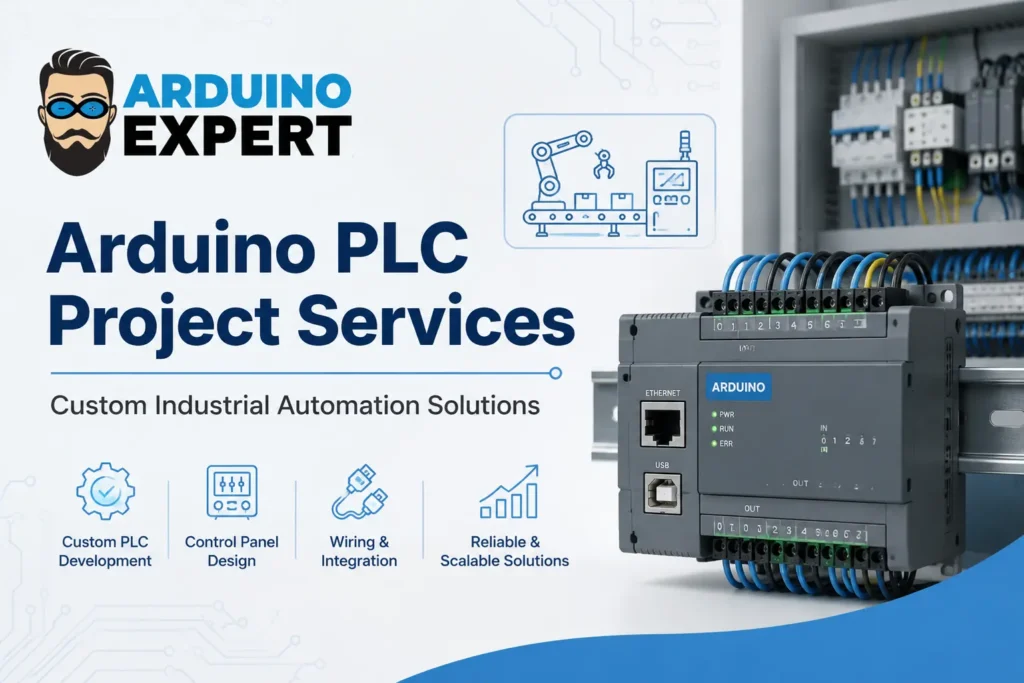
Modern industries need automation systems that are reliable, flexible, easy to maintain, and suitable for future expansion. Whether a business wants to automate a machine, control pumps and motors, monitor a production process, or connect industrial equipment to an online dashboard, choosing the right controller and development approach is essential.
A professional Arduino PLC project service helps businesses turn an automation idea into a complete working system. It can include requirement analysis, PLC selection, electrical design, control logic development, sensor and actuator integration, HMI programming, IoT connectivity, testing, documentation, and commissioning.
Arduino-compatible PLCs combine the flexibility of the Arduino ecosystem with features designed for industrial control. Platforms such as M-DUINO, CONTROLLINO, Arduino Opta, and Portenta Machine Control can be used for machine automation, process control, monitoring, data acquisition, and Industrial IoT applications. The correct platform depends on the required inputs and outputs, communication protocols, environmental conditions, safety requirements, and system complexity.
At Arduino Expert, our Arduino PLC project services cover custom automation development using industrial Arduino-compatible controllers, sensors, motors, valves, relays, HMIs, communication modules, cloud platforms, and control-panel components. Our existing services include process automation, PID control, remote monitoring, data logging, hardware integration, HMI development, and control-cabinet support.
What Is an Arduino PLC?
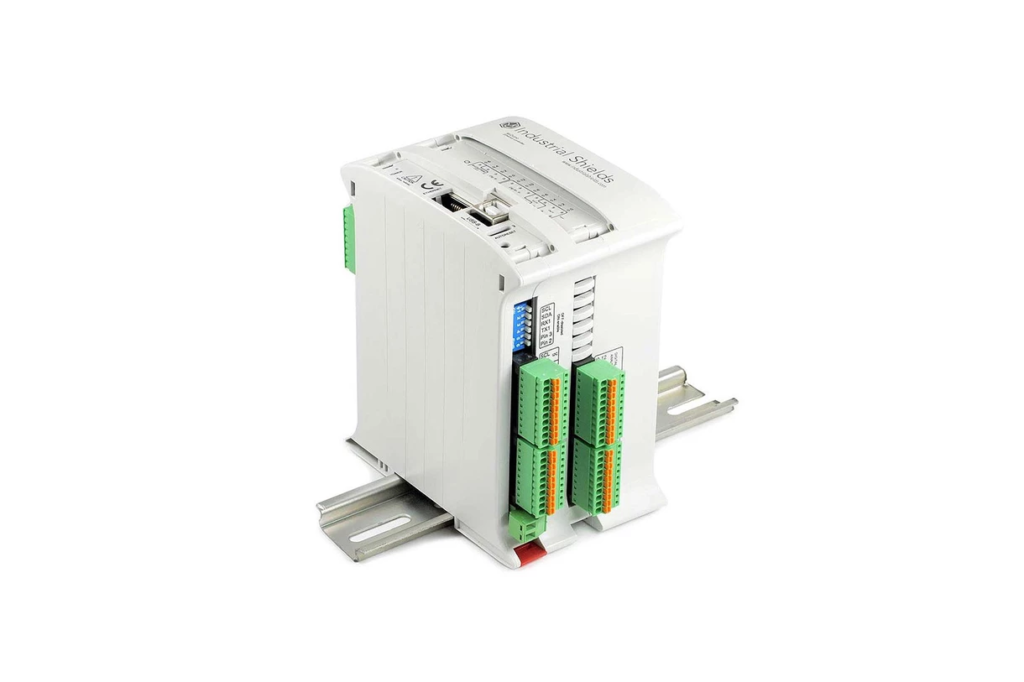
An Arduino PLC is a programmable controller that combines Arduino-compatible hardware or software with an industrial control format.
Unlike a standard Arduino development board, an industrial Arduino-compatible PLC may provide:
- DIN-rail mounting
- Industrial-voltage digital inputs
- Relay or transistor outputs
- Analog inputs and outputs
- Electrical isolation
- Screw-terminal connections
- Ethernet and RS-485 communication
- Modbus support
- Watchdog and recovery functions
- Expandable input and output modules
- Hardware designed for installation inside control panels
Some controllers are programmed primarily through the Arduino IDE using C or C++, while others support traditional PLC programming methods.
For example, the Arduino PLC IDE supports Ladder Diagram, Functional Block Diagram, Structured Text, Sequential Function Chart, and Instruction List. It can also combine IEC 61131-3 PLC programming with Arduino sketches and includes tools for Modbus RTU, Modbus TCP, and CANopen communication.
This flexibility allows developers to choose a programming method that matches the project and the technical background of the maintenance team.
Arduino PLC vs a Standard Arduino Board
A standard Arduino board is excellent for education, experimentation, rapid prototyping, and many embedded projects. However, placing a basic development board directly inside an industrial machine is not always appropriate.
Industrial equipment may involve:
- 12 V or 24 V sensor signals
- AC motors and contactors
- Solenoid valves
- Variable-frequency drives
- Electrical noise
- Voltage spikes
- Long cable runs
- Continuous operation
- Temperature variation
- Emergency-stop circuits
- Maintenance requirements
A standard Arduino board normally requires additional interface circuits, isolation modules, industrial power supplies, relay boards, terminal blocks, and protective components before it can work reliably with this equipment.
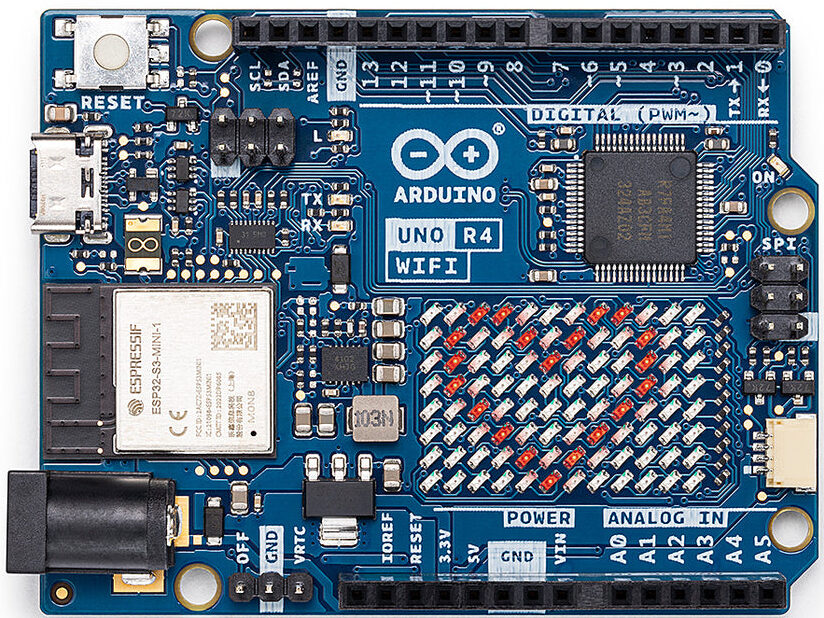
An Arduino-compatible PLC packages many of these requirements into a more installation-friendly controller.
| Feature | Standard Arduino board | Arduino-compatible PLC |
| Main purpose | Learning and prototyping | Automation and control |
| Typical signal level | 3.3 V or 5 V | Often supports industrial voltages |
| Mounting | Development-board format | Frequently DIN-rail mountable |
| Electrical isolation | Usually requires external circuits | Available on selected models |
| Wiring | Pin headers | Screw or industrial terminals |
| Relay outputs | Usually external | Available on selected models |
| Communication | Depends on shields or modules | Ethernet, RS-485, or other interfaces may be built in |
| Control-panel integration | Requires additional design | Usually easier |
| Maintenance | Prototype-oriented | More suitable for organized field wiring |
| Programming | Primarily Arduino sketches | Arduino code, PLC languages, or both |
The final choice should not be based only on price. It should be based on operational reliability, electrical requirements, maintainability, expansion needs, and the consequences of equipment failure.
What Does an Arduino PLC Project Services Include?
A complete Arduino PLC project services goes beyond writing a few lines of code. It brings together software, electronics, electrical control, mechanical operation, communication, and user-interface requirements.
1. Requirement Analysis
The first stage is understanding what the machine or process must do.
Important questions include:
- What operation needs to be automated?
- Which actions are currently performed manually?
- How many sensors are required?
- Which motors, pumps, heaters, valves, or actuators must be controlled?
- Is manual operation required in addition to automatic mode?
- What should happen during a fault?
- Does the system need an HMI?
- Is remote monitoring required?
- What information should be logged?
- Will the system need future expansion?
A proper functional specification should be prepared before hardware selection and programming begin.
2. Input and Output Planning
Every sensor, switch, button, motor, valve, relay, and alarm must be included in an input/output list.
Typical inputs include:
- Start and stop buttons
- Emergency status contacts
- Limit switches
- Proximity sensors
- Level sensors
- Temperature sensors
- Pressure transmitters
- Flow sensors
- Encoders
- Current sensors
- Fault contacts
- Analog 0–10 V signals
- Analog 4–20 mA signals
Typical outputs include:
- Relays
- Contactors
- Solenoid valves
- Pumps
- Indicator lights
- Buzzers
- Stepper motor drivers
- Servo drives
- Variable-frequency drives
- Heating elements
- Pneumatic actuators
The I/O list determines how many digital, analog, PWM, relay, and communication channels the controller must provide.
3. Arduino PLC Selection
The selected PLC must match both the current project and likely future requirements.
Common platform options include:
M-DUINO
M-DUINO is an Arduino Mega-based industrial PLC family available in different I/O configurations. Its models can include Ethernet, RS-485, RS-232, Modbus communication, MQTT, I²C, SPI, and UART support, depending on the selected controller.
It can be suitable for:
- Data acquisition
- Pump and valve control
- Dosing systems
- Process automation
- Remote monitoring
- Machines requiring multiple I/O points
CONTROLLINO
CONTROLLINO provides industrial PLC hardware compatible with the Arduino ecosystem. Its product range is designed to support applications from prototyping to industrial automation while retaining open-source programming flexibility.
It can be considered for:
- Machine control
- Motor sequencing
- Cutting and feeding systems
- Conveyor automation
- Relay-based control
- Custom production equipment
Arduino Opta
Arduino Opta is a micro PLC developed for industrial and building automation. Depending on the model, it can provide Ethernet, RS-485, Wi-Fi, and Bluetooth connectivity. It supports Arduino sketches and IEC 61131-3 PLC programming languages and can be installed on a DIN rail.
It can be suitable for:
- Building automation
- Compact control systems
- Remote equipment monitoring
- Energy management
- Connected automation
- Small machines and process controllers
Portenta Machine Control
Portenta Machine Control is intended for industrial control, equipment monitoring, and machine development. It offers industrial communication and configurable I/O around the Portenta platform.
The best controller is not always the largest or most expensive one. The correct choice is the controller that satisfies the electrical, control, communication, maintenance, and expansion requirements of the application.
4. Electrical and Control-System Design
PLC programming cannot compensate for incorrect electrical design.
A professional system may require:
- Industrial power supplies
- Circuit protection
- Fuses and breakers
- Relays and contactors
- Motor protection
- Terminal blocks
- Signal isolation
- Flyback protection
- Surge suppression
- Cable shielding
- Grounding arrangements
- Control-panel ventilation
- Manual selector switches
- Status indicators
- Emergency-stop and safety circuits
Safety-related functions should be implemented with hardware and control components appropriate to the required safety level. Standard control logic should not be treated as a replacement for a properly designed safety system.
For projects moving toward a custom controller or commercial product, our PCB design services can support schematic development, PCB layout, prototyping, and manufacturing preparation.
5. PLC Programming and Control Logic
The PLC program defines how the system reacts to inputs and controls outputs.
Programming may include:
- Manual and automatic modes
- Start and stop sequences
- Timers and counters
- Motor sequencing
- Interlocks
- Alarm handling
- Sensor filtering
- Analog scaling
- PID control
- Recipe selection
- Production counting
- Fault recovery
- Power-loss recovery
- Data storage
- Communication routines
- Maintenance modes
The program should be structured into clear functions rather than placed inside one long section of code. Useful naming, comments, state-based logic, and fault handling make future maintenance much easier.
Our Arduino programming service includes code development, debugging, sensor integration, communication configuration, library development, firmware optimization, and testing on hardware.
6. HMI and Operator Interface Development
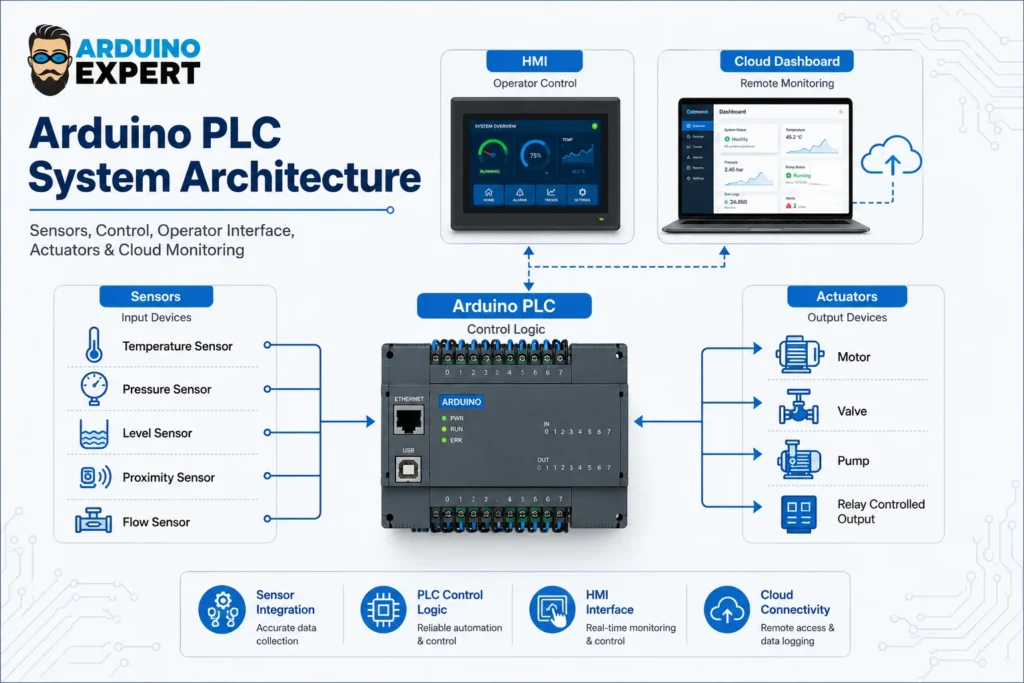
An HMI allows operators to view the machine status and control approved functions.
A PLC and HMI development service may include screens for:
- System overview
- Start and stop controls
- Manual and automatic mode
- Live sensor readings
- Motor and valve status
- Alarm history
- Production counters
- Recipe configuration
- Timing parameters
- User access levels
- Maintenance functions
- Calibration
- Network configuration
A good HMI should be easy to understand during normal operation and during a fault. Important alarms should be clear, but operators should not be overloaded with unnecessary information.
7. Industrial Communication
Modern automation systems rarely work as isolated controllers. They often communicate with HMIs, drives, remote I/O modules, energy meters, computers, or cloud platforms.
Common communication options include:
- RS-485
- Modbus RTU
- Modbus TCP
- Ethernet
- CAN or CANopen
- UART
- I²C
- SPI
- Wi-Fi
- Bluetooth
- GSM or cellular communication
- MQTT
- HTTPS
The communication method should be selected according to distance, speed, electrical environment, network availability, device compatibility, and cybersecurity requirements.
8. IoT and Remote Monitoring
An Arduino PLC system can also become part of an Industrial IoT solution.
Possible remote features include:
- Live machine status
- Production dashboards
- Temperature and pressure trends
- Equipment runtime
- Tank-level monitoring
- Fault notifications
- Remote parameter updates
- Maintenance reminders
- Historical data
- Energy-consumption reports
- Multi-location device monitoring
Our IoT project development services can connect controllers, sensors, communication hardware, databases, web dashboards, and remote-management systems. A custom interface can also be developed through our web and app development services.
Remote control must be designed carefully. Authentication, user permissions, secure communication, safe fallback behavior, and local manual control should be considered during system design.
9. Testing and Troubleshooting
Testing should begin before the system is installed on the final machine.
A structured test process may include:
- Individual input testing
- Individual output testing
- Sensor calibration
- Manual-mode testing
- Automatic-sequence testing
- Alarm testing
- Communication testing
- Power-cycle testing
- Fault-condition testing
- Long-duration operation
- HMI testing
- Data-logging verification
- Network-disconnection testing
- Recovery after power failure
Factory Acceptance Testing can be used to confirm that the system follows the agreed control sequence before final installation.
10. Documentation and Handover
A professional project should be understandable after delivery.
Documentation may include:
- Functional description
- Input/output list
- Wiring diagram
- Electrical schematic
- PLC source code
- HMI project files
- Communication settings
- Operating instructions
- Alarm list
- Parameter list
- Maintenance guidance
- Component list
- Backup and restore instructions
Documentation reduces dependency on one programmer and makes troubleshooting, maintenance, and future upgrades easier.
How the Arduino PLC Project Development Process Works
A structured development process helps reduce errors, unexpected costs, and redesign.
Step 1: Share the Project Requirements
The client explains the machine, process, current problem, and desired output. Photos, videos, sketches, existing wiring diagrams, sensor specifications, and sequence descriptions can be useful.
Step 2: Prepare the Functional Scope
The complete operating sequence is documented, including manual control, automatic operation, alarms, interlocks, communication, and recovery behavior.
Step 3: Select the Hardware
The PLC, sensors, relays, drives, HMI, power supply, control components, and communication hardware are selected.
Step 4: Develop the Control Logic
PLC programming, communication routines, HMI screens, alarms, and data-handling functions are developed according to the agreed scope.
Step 5: Assemble and Integrate the System
The controller is connected to representative sensors, actuators, displays, relays, or simulation hardware.
Step 6: Test Each Function
Inputs, outputs, sequences, alarms, communication, and fault recovery are tested individually and as a complete system.
Step 7: Install and Commission
The final system is connected to the machine or process, adjusted to actual operating conditions, and tested with real equipment.
Step 8: Deliver Documentation and Support
Source files, instructions, system backups, and agreed documentation are supplied. Future upgrades or troubleshooting support can be arranged according to the project.
For a broader overview of developing complete embedded projects, read our guide on how Arduino project development works.
Applications of Arduino PLC Automation
Arduino-compatible PLCs can be used in many small-to-medium control systems, research setups, custom machines, and connected automation applications.
Machine Automation
Examples include:
- Automatic cutting machines
- Filling machines
- Packaging systems
- Material feeders
- Labeling systems
- Test equipment
- Custom production machines
- Pick-and-place mechanisms
Pump and Tank Control
A PLC can monitor tank levels, start and stop pumps, operate valves, alternate between multiple pumps, detect dry-running conditions, and generate alarms.
Dosing and Mixing Systems
Automation can improve repeatability when dispensing powders, liquids, chemicals, fertilizers, ingredients, or laboratory materials.
Conveyor Control
A controller can operate conveyor motors, detect products, count items, manage stops, coordinate stations, and identify jams.
Temperature and Process Control
Applications may include:
- Industrial ovens
- Incubators
- Environmental chambers
- Heating systems
- Cooling systems
- Fermentation equipment
- Drying processes
Data Acquisition and Monitoring
An Arduino PLC can collect readings from temperature, pressure, flow, current, voltage, level, vibration, and other sensors.
Agriculture and Water Management
Possible systems include:
- Irrigation control
- Pump automation
- Fertilizer dosing
- Greenhouse control
- Water-level monitoring
- Remote field monitoring
Research and Laboratory Automation
Custom research systems may require unusual sequences, flexible programming, data logging, and integration with specialized sensors. Arduino-compatible platforms can be useful when requirements do not fit a standard off-the-shelf machine.
Real Arduino PLC Project Examples
The best way to understand an Arduino PLC project service is to examine real applications.
Automatic Cutting Machine Using CONTROLLINO Mega
Arduino Expert developed an automatic cutting machine using CONTROLLINO Mega PLC.
The system was designed to automate material feeding and cutting through stepper motors, relays, push buttons, manual controls, and an automatic operating sequence. Adjustable parameters included feed steps, cutting steps, speed, loop count, and timing delays.
This type of solution can be adapted for wire, tubing, rope, packaging material, plastic extrusion, or similar repetitive cutting applications.
Smart Powder Dosing and Mixing System Using M-DUINO
Another example is the smart powder dosing and solution mixing system using M-DUINO 21 Plus PLC.
The project automated powder dosing, water filling, mixing, maturation, and solution discharge. It used level switches, valves, a pump, a stepper-driven auger, Ethernet communication, data handling, and remote parameter updates.
These projects demonstrate how one Arduino PLC platform can be adapted to very different machines and processes.
More examples are available in our Arduino PLC project portfolio.
Benefits of Custom Arduino PLC Project Services
Flexible Development
Arduino-compatible platforms provide access to a large ecosystem of libraries, sensors, communication modules, and development resources.
Custom Control Logic
The system can be designed around the exact machine sequence instead of forcing the process to fit a generic controller.
IoT Integration
Ethernet, Wi-Fi, GSM, MQTT, HTTPS, and Modbus can connect the controller to dashboards, servers, apps, and other equipment.
Easier Prototyping
A concept can be tested and improved before investing in a larger production design.
Expandable Systems
Additional sensors, outputs, communication modules, HMI screens, or remote features can be included when the hardware and software architecture are planned correctly.
Reduced Manual Work
Repetitive actions can be performed automatically, allowing operators to focus on supervision, material handling, quality, and maintenance.
Improved Repeatability
Automated timing, measurement, sequencing, and interlocks can make operations more consistent.
Data Visibility
Machine status, process values, runtime, alarms, and production data can be stored and displayed for operational review.
When Is an Arduino PLC a Good Choice?
An Arduino-compatible PLC may be suitable when:
- The machine requires custom control logic
- The project needs unusual sensors or communication modules
- IoT integration is important
- A prototype may later become a production system
- The system is small or medium in scale
- Flexible programming is required
- Open development is preferred
- The equipment requires data logging or remote monitoring
- A traditional PLC solution would be unnecessarily restrictive
- The development team needs access to both Arduino and PLC programming methods
When Should Another PLC or Control Platform Be Considered?
An Arduino PLC is not automatically the best controller for every project.
A different platform may be preferable when:
- The facility has standardized all machines on one PLC brand
- The maintenance team is trained only on a specific vendor ecosystem
- The system requires certified safety PLC functions
- Complex multi-axis motion control is required
- The process depends on specialized proprietary industrial networks
- The application has strict qualification or regulatory requirements
- A large existing plant infrastructure must be integrated
- Local replacement-part availability is a major concern
A professional developer should recommend hardware based on the project requirements rather than forcing every project onto one platform.
For larger or broader factory-control requirements, explore our industrial automation services, which include PLC-based systems, control panels, industrial monitoring, motor and pump automation, conveyors, HMIs, and Industrial IoT solutions.
How Much Does an Arduino PLC Project Cost?
There is no single fixed cost because every automation project has different requirements.
The total cost may depend on:
- Number of digital inputs
- Number of digital outputs
- Analog signal requirements
- Selected PLC model
- Sensors and actuators
- Motor and drive requirements
- Control-panel size
- Electrical protection
- HMI screen count
- PLC programming complexity
- Communication protocols
- IoT dashboard requirements
- Mechanical integration
- Testing time
- Documentation
- On-site installation
- Commissioning
- Future support
A basic controller with a few switches, relays, and a simple sequence will require less development than a complete machine with analog control, HMI screens, recipes, remote monitoring, data logging, multiple motors, and fault recovery.
The most reliable way to calculate the cost is to prepare a clear scope that includes:
- The required machine operation
- A list of sensors and controlled equipment
- Manual and automatic functions
- Communication requirements
- HMI or dashboard requirements
- Expected project deliverables
- Installation location
- Required completion stage
Providing these details allows the development team to recommend suitable hardware and prepare a realistic quotation.
How to Choose an Arduino PLC Development Company
Before selecting a developer, review more than the quoted price.
A capable Arduino PLC project service provider should understand:
- Arduino and embedded programming
- Industrial I/O
- Sensors and actuators
- Relays and contactors
- Motors and motor drivers
- Electrical protection
- Control-panel wiring
- PLC sequencing
- HMI development
- Modbus and industrial communication
- IoT integration
- Testing and fault handling
- Technical documentation
Ask the developer:
- Have you completed similar automation projects?
- Will the project be tested on real hardware?
- Which source files will be delivered?
- Will wiring documentation be included?
- How will faults and power failures be handled?
- Can the system be expanded later?
- Is remote troubleshooting available?
- Who will support installation and commissioning?
- How will access to remote-control features be secured?
- Are replacement components readily available?
A low-cost program without proper electrical design, testing, documentation, or support can become expensive when installed on a real machine.
Why Choose Arduino Expert?
Arduino Expert provides end-to-end engineering services for custom electronics, automation, embedded systems, IoT, product development, programming, PCB design, and app development. This makes it possible to develop the PLC controller and the supporting hardware, interface, communication, and product components within one coordinated workflow.
Our Arduino PLC project services can include:
- Requirement and feasibility analysis
- Arduino PLC selection
- Input/output planning
- Custom PLC programming
- Manual and automatic control modes
- Sensor and actuator integration
- Motor, pump, valve, and relay control
- Analog sensor interfacing
- PID control
- HMI development
- Modbus and industrial communication
- IoT dashboards
- Remote monitoring
- Data logging
- Control-panel integration support
- Hardware testing
- Troubleshooting
- Documentation
- Future modifications
Whether you need to automate a small machine, develop an industrial prototype, monitor equipment remotely, or create a complete connected control system, the project can be designed according to your functional and operational requirements.
Start Your Arduino PLC Automation Project
A successful automation system starts with a clear understanding of the process.
Share the following information with our team:
- A description of the machine or process
- Photos or videos of the current setup
- Required automatic sequence
- Available power supply
- List of sensors
- List of motors, pumps, valves, or actuators
- Required operator controls
- HMI requirements
- Remote-monitoring requirements
- Installation location
- Required deliverables
Our team can review the requirements and recommend a suitable controller, development approach, communication method, and project scope.
Frequently Asked Questions
What are Arduino PLC project services?
An Arduino PLC project services provide professional development for designing, programming, testing, and integrating an automation system using an Arduino-compatible PLC. It may include PLC selection, control logic, sensors, actuators, HMI development, communication, IoT integration, control-panel support, and documentation.
Can Arduino be used as a PLC?
A standard Arduino board can execute control logic, but industrial applications often require additional protection, signal conditioning, isolation, terminals, and power-control hardware. An Arduino-compatible industrial PLC provides a more suitable format for many machine and process-control applications.
Which Arduino PLC is best for industrial automation?
The best controller depends on the number and type of I/O points, communication requirements, programming method, electrical environment, processing needs, expansion plans, and required certifications. M-DUINO, CONTROLLINO, Arduino Opta, and Portenta Machine Control are possible options for different applications.
Can an Arduino PLC control motors?
Yes. An Arduino PLC can send control signals to relays, contactors, stepper drivers, servo drives, and variable-frequency drives. The motor should be operated through correctly rated control and protection equipment rather than directly from the PLC output.
Can an Arduino PLC communicate with an HMI?
Yes. Communication may use Modbus RTU, Modbus TCP, Ethernet, serial communication, or another protocol supported by both devices.
Can an Arduino PLC connect to the internet?
Yes. Depending on the controller and communication hardware, it may connect through Ethernet, Wi-Fi, or cellular communication. It can send data to a cloud server, dashboard, mobile application, or remote-monitoring platform.
Do you develop Arduino PLC projects?
Yes we develop arduino based PLC projects. The required documentation and project scope should be agreed before development.