
Beekeeping is evolving rapidly with the integration of modern technologies such as the Internet of Things (IoT), wireless sensor networks, cloud computing, artificial intelligence (AI), and mobile applications. Traditional beekeeping methods rely heavily on manual hive inspections, but modern beehive monitoring systems allow beekeepers to observe important colony conditions remotely, collect valuable data, and respond to potential problems more efficiently.
A smart beehive monitoring system uses electronic sensors and connected devices to measure parameters such as hive weight, internal temperature, humidity, bee activity, environmental conditions, and movement. The collected information can be transmitted through Wi-Fi, GSM, 4G LTE, LoRa, or other wireless technologies and displayed on a smartphone application or cloud dashboard.
These systems are increasingly relevant to hobbyist beekeepers, commercial apiary owners, agricultural researchers, and companies developing smart farming solutions.
For example, a remotely connected hive scale can help beekeepers observe changes in hive weight throughout the nectar-flow season. Temperature sensors may provide insights into the conditions inside the brood chamber, while movement sensors and location tracking can help identify possible hive disturbances.
Advanced monitoring systems can also integrate acoustic sensors, bee traffic counters, cameras, predictive analytics, and automated notifications.
In this comprehensive guide, we will explore how beehive monitoring systems work, their components, sensor options, communication technologies, monitoring software, implementation costs, practical applications, and the future of IoT smart beekeeping.
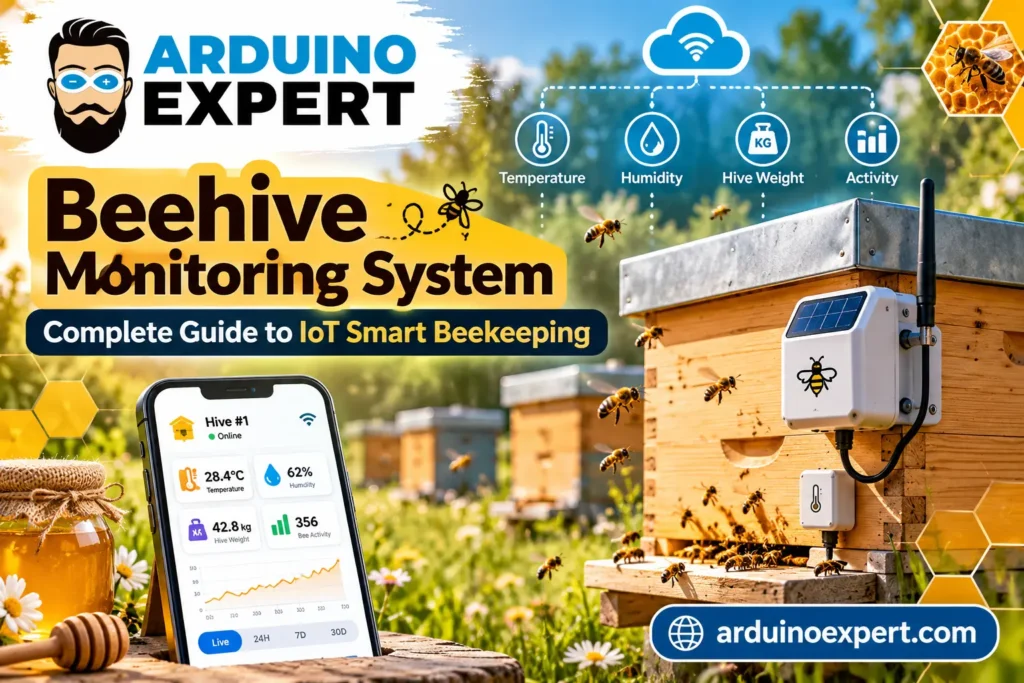
What Is a Beehive Monitoring System?
A beehive monitoring system is an electronic solution designed to continuously or periodically measure conditions inside and around a honey bee colony.
Instead of relying exclusively on physical inspections, beekeepers can collect data through electronic sensors installed in or around the hive.
The system processes this information and makes it available through a local display, mobile application, web dashboard, or automated notification system.
Depending on its design, a smart beehive monitoring system can measure:
- Total beehive weight and weight changes
- Internal hive temperature
- Relative humidity inside the hive
- Ambient temperature and environmental conditions
- Bee entrance and exit activity
- Sound and vibration patterns
- Carbon dioxide concentration
- Hive movement, tilt, or possible theft
- GPS location
- Battery voltage and solar charging status
Not every beehive monitoring system requires all these sensors.
A simple electronic beehive scale may only measure weight, while an advanced IoT-based beehive monitoring system can collect data from multiple sensors across hundreds of hives.
The objective is to provide beekeepers with useful information that supports better decision-making, reduces unnecessary disturbance, and improves apiary management.
It is important to understand that electronic monitoring supports traditional beekeeping knowledge. Sensor readings alone cannot reliably diagnose every colony health problem, and physical inspections remain necessary.

What Is IoT Smart Beekeeping?
IoT smart beekeeping, also called precision beekeeping, involves using connected sensors, digital monitoring systems, and data analysis to support the management of honey bee colonies.
The Internet of Things allows physical devices to collect and exchange information over communication networks.
In beekeeping, this technology connects the hive environment with digital monitoring platforms.
For example, a connected beehive scale may measure weight several times per day and upload the readings to a cloud database.
A beekeeper can then open a mobile application and view the latest weight, temperature, humidity, and historical trends without visiting the apiary.
If the system detects an unusual change, it may generate an SMS, email, or push notification.
Benefits of IoT in Beekeeping
Remote hive monitoring: Check colony-related measurements without traveling to every apiary.
Reduced unnecessary inspections: Use monitoring data to help decide when a closer inspection is worthwhile.
Honey-flow monitoring: Observe hive weight trends during nectar collection periods.
Early warning indicators: Identify unusual temperature changes, weight losses, or reduced bee activity that may require investigation.
Winter monitoring: Track hive weight changes and possible consumption of stored food.
Better apiary management: Compare performance across multiple colonies and locations.
Data-driven decisions: Use historical information alongside weather conditions, inspection records, and beekeeper experience.
Improved operational efficiency: Prioritize visits to hives showing unusual changes rather than inspecting every colony with the same frequency.
Smart beekeeping does not eliminate traditional hive management. Instead, it provides additional information that can make beekeeping activities more informed and efficient.
How Does an IoT Beehive Monitoring System Work?
A typical IoT beehive monitoring system consists of several interconnected components.
Step 1: Sensor Data Collection
Electronic sensors measure different physical and environmental parameters.
For example:
- A load cell measures beehive weight.
- A temperature sensor measures internal hive temperature.
- A humidity sensor measures moisture conditions.
- A microphone records acoustic signals.
- A motion sensor detects movement or unexpected tilt.
Step 2: Data Processing
A microcontroller or embedded computing device receives the sensor readings.
It converts raw sensor information into meaningful measurements, applies calibration factors, filters noise, and prepares the data for storage or transmission.
The processing hardware may be based on an ESP32, Arduino-compatible controller, STM32, Raspberry Pi, or a custom embedded circuit.
Step 3: Wireless Communication
The processed information is transmitted through an appropriate communication network.
Depending on the apiary location, the system may use:
- Wi-Fi
- Bluetooth Low Energy
- GSM or 4G LTE
- LTE-M or NB-IoT
- LoRa or LoRaWAN
- Other local wireless networks
Step 4: Data Storage
Sensor readings may be stored in local memory, an SD card, a gateway, or a cloud database.
Cloud storage is particularly useful for maintaining historical records and monitoring multiple hives.
Step 5: Visualization and Alerts
A mobile application or web dashboard displays the latest readings, historical graphs, and device status.
The software may also generate alerts when readings exceed configured limits.
For instance, an unusual hive weight drop may trigger a notification requesting an inspection.
Typical System Architecture
Beehive Sensors → Embedded Controller → Wireless Communication → Gateway or Cloud Server → Mobile App / Web Dashboard → Alerts and Analysis
For remote locations, the communication path may involve multiple stages.
A LoRa sensor node, for example, can transmit information to a gateway that forwards it to the internet using 4G.
This modular approach allows a beehive monitoring solution to grow from a simple single-hive device into a complete smart apiary monitoring network.
Working Video Demo of a IoT Beehive Monitoring System by Arduino Expert
Important Parameters to Monitor in a Beehive
One of the most important decisions in designing a beehive monitoring system is determining which parameters provide useful information.
Different measurements serve different purposes.
1. Beehive Weight Monitoring
Beehive weight monitoring is one of the most practical applications of smart beekeeping technology.
A digital beehive scale measures the total weight of the hive and records changes over time.
Hive weight may change because of:
- Nectar and pollen collection
- Honey production and harvesting
- Consumption of stored food
- Water accumulation or evaporation
- Equipment being added or removed
- Colony activity and bee movement
- Environmental conditions
- Hive disturbance or theft
By analyzing weight changes over days or weeks, beekeepers can gain insights into colony productivity and seasonal trends.
For example, increasing net hive weight during a nectar flow may indicate that the colony is accumulating resources.
A gradual reduction in weight during winter may reflect consumption of stored food.
However, weight change is not a direct measurement of honey production. Brood, bees, moisture, pollen, equipment, and other factors also affect total mass.
Electronic Hive Scale Components
A typical digital hive scale may include:
- Single-point, shear-beam, or multiple load cells
- Load cell mounting frame or weighing platform
- HX711, NAU7802, or another precision measurement interface
- Microcontroller or data logger
- Power supply
- Optional wireless communication module
- Optional cloud platform or mobile application
Load cells convert mechanical force into electrical signals. A precision interface measures these small signals and converts them into digital values.
For long-term outdoor monitoring, proper mechanical installation and calibration are essential.
The weighing structure should support the full hive load without unwanted contact that bypasses the sensors. Temperature compensation, protection from moisture, and stable mounting can also improve measurement reliability.
Related Arduino Expert Project: Explore our practical IoT Bee Hive Weight Scale with Arduino and SIM800L, which demonstrates hive weight measurement, temperature and humidity sensing, LCD display, and SMS-based monitoring.
2. Beehive Temperature Monitoring
Temperature is another important parameter in a smart beehive monitoring system.
Honey bee colonies regulate temperature within important areas of the hive, particularly around developing brood.
Temperature monitoring can help beekeepers observe thermal patterns and detect unusual changes.
Common sensor technologies include:
- DS18B20 digital temperature sensors
- DHT22 combined temperature and humidity sensors
- SHT31 and SHT35 environmental sensors
- Thermistors
- Thermocouples for specialized measurements
- Infrared temperature sensors
- Thermal imaging systems
Sensor selection depends on accuracy, physical size, energy consumption, placement, and environmental conditions.
Multiple sensors may be installed in different hive locations to observe temperature distribution.
A sensor near the brood area will produce different readings from a sensor near the entrance or outer wall.
Important: A single temperature reading cannot confirm whether the queen is present or whether the colony is healthy. Seasonal behavior, ambient weather, sensor location, and colony size must also be considered.
3. Beehive Humidity Monitoring
Humidity monitoring provides information about moisture conditions inside a hive.
Honey bees influence internal moisture through ventilation, metabolic activity, nectar processing, and environmental interactions.
Excessive moisture and condensation may contribute to unfavorable hive conditions, particularly in colder seasons.
Humidity sensors can help observe changes over time and compare conditions between colonies.
Common options include DHT22, SHT31, SHT35, BME280, and other digital environmental sensors.
In outdoor installations, sensors must be protected against condensation, propolis buildup, contamination, and direct contact with bees.
Humidity readings should be interpreted together with temperature, weather conditions, and hive design.
4. Bee Activity and Traffic Monitoring
Bee activity monitoring systems estimate movement around the hive entrance.
These systems may use:
- Infrared entrance counters
- Optical sensors
- Camera-based monitoring
- Computer vision
- Radar or other specialized motion sensing
- Acoustic analysis
A bee traffic counting system attempts to estimate the number of bees entering and leaving the hive.
Such measurements may help identify changes in foraging activity and seasonal behavior.
However, accurately counting bees is challenging because several bees may cross a sensor simultaneously, reverse direction, or obscure one another.
Entrance activity is also affected by weather, temperature, daylight, nectar availability, and colony strength.
For these reasons, traffic counts should generally be treated as estimates rather than exact colony population measurements.
5. Acoustic Beehive Monitoring
An acoustic beehive monitoring system uses microphones or specialized vibration sensors to collect signals produced by the colony.
Honey bees generate sound and vibration through flight, communication, movement, and other activities.
Researchers are exploring whether acoustic patterns can provide indicators of:
- Changes in overall colony activity
- Swarming-related behavior
- Queen-related conditions
- Stress or disturbance
- Seasonal and daily behavioral patterns
Acoustic monitoring systems may use MEMS microphones, digital microphones, piezoelectric sensors, accelerometers, or contact microphones.
Advanced systems process signals using frequency analysis, digital filtering, machine learning, and pattern recognition.
Although promising, acoustic interpretation remains challenging. Different colony conditions may produce overlapping signals, and external noise can influence measurements.
Therefore, automated acoustic alerts should be considered possible indicators requiring confirmation.
6. Carbon Dioxide and Air Quality Monitoring
Advanced beehive monitoring systems may include carbon dioxide sensors to study ventilation and gas concentration inside the hive.
Possible sensor technologies include:
- NDIR carbon dioxide sensors
- Temperature and humidity sensors
- Environmental gas sensors for research applications
CO₂ measurements may provide additional information about ventilation, colony activity, and environmental dynamics.
However, gas sensors introduce extra cost, power requirements, calibration needs, and installation challenges.
Some general-purpose air-quality sensors estimate gas-related indices rather than directly measuring CO₂. These should not be presented as equivalent to a calibrated CO₂ measurement.
7. Hive Movement, Tilt, and Theft Detection
Commercial apiaries may face problems involving hive theft, animal disturbances, accidental movement, or unauthorized handling.
A smart monitoring device can include:
- Accelerometers
- Gyroscopes
- Tilt sensors
- Vibration sensors
- GPS or GNSS modules
- Tamper switches
- Sudden weight-change detection
When unusual movement occurs, the monitoring system can generate an alert.
GPS tracking can be particularly useful for mobile beekeeping operations, although it adds power consumption and recurring connectivity considerations.
Movement detection alone does not establish that theft has occurred. Wind, animals, transportation, or normal handling may also trigger the system.
8. Environmental and Weather Monitoring
Weather conditions influence honey bee activity and foraging opportunities.
A smart apiary can integrate an external weather station to monitor:
- Ambient temperature
- Relative humidity
- Rainfall
- Wind speed and direction
- Atmospheric pressure
- Solar radiation
- Light intensity
Combining weather data with hive measurements provides additional context.
For example, reduced entrance activity during rain may be expected and should not automatically trigger an alert about colony weakness.
Sensors and Components Used in Smart Beehive Monitoring
A complete smart beehive monitoring system can incorporate different components depending on its purpose.
| Component | Available Technologies | Main Function |
| Weight sensor | Load cell, strain gauge scale | Monitor hive weight |
| Precision interface | HX711, NAU7802, industrial ADC | Read load cell signals |
| Temperature sensor | DS18B20, thermistor, SHT series | Monitor hive temperature |
| Humidity sensor | DHT22, SHT31, BME280 | Monitor relative humidity |
| Acoustic sensor | MEMS microphone, contact microphone | Observe sound patterns |
| Vibration sensor | Accelerometer, piezoelectric sensor | Monitor movement or vibrations |
| Bee counter | Infrared, optical, camera | Estimate entrance activity |
| Gas sensor | CO₂ sensor | Study ventilation |
| Camera | USB, IP, embedded camera | Visual activity monitoring |
| Position sensor | GPS/GNSS | Track hive location |
| Motion sensor | Accelerometer, tilt switch | Detect movement |
| Weather sensor | Rain, wind, light, pressure sensors | Monitor local weather |
| Controller | ESP32, Arduino, STM32, RP2040 | Process sensor readings |
| Gateway | Raspberry Pi, industrial IoT gateway | Connect multiple devices |
| Wireless module | Wi-Fi, LoRa, LTE, BLE | Transmit information |
| Storage | SD card, flash, cloud database | Store historical records |
| Power supply | Battery, solar, DC adapter | Power electronics |
| Display | LCD, OLED, e-paper | Show local readings |
| Enclosure | Weather-resistant electronics housing | Protect hardware |
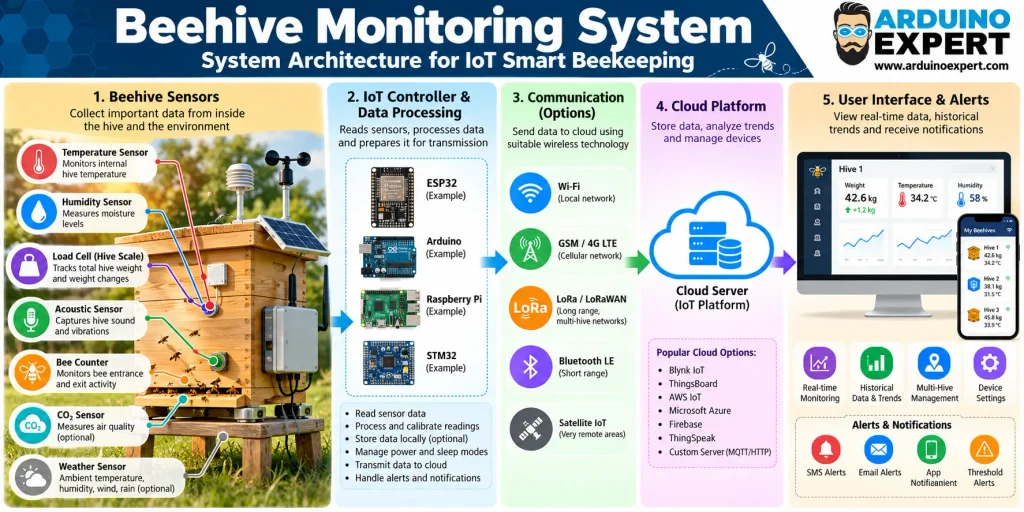
Not every application needs all these components.
A basic system may contain only a weight sensor and communication module, while a research-grade installation may combine several measurement techniques.
The best design balances useful information, installation complexity, reliability, maintenance requirements, and budget.
Wireless Communication Technologies for Beehive Monitoring
Wireless communication is an essential part of remote beehive monitoring.
The best communication technology depends on the location, number of hives, available infrastructure, data requirements, and power budget.
1. Wi-Fi Beehive Monitoring System
Wi-Fi is suitable for apiaries located near houses, agricultural buildings, or other areas with reliable wireless internet access.
Advantages include straightforward cloud connectivity, relatively inexpensive hardware, and compatibility with common IoT platforms.
Limitations include network range, relatively high active power consumption, and dependence on local infrastructure.
2. GSM and 4G Beehive Monitoring System
Cellular monitoring is useful when Wi-Fi is not available but a mobile network provides adequate coverage.
A cellular monitoring device uses a SIM-enabled modem to send readings through a mobile network.
Depending on the hardware and network, it may support:
- Internet data transmission
- SMS alerts
- Remote cloud access
- Periodic uploads
- Remote configuration
Older projects commonly use GSM/GPRS modules such as SIM800L.
Modern deployments may use compatible 4G LTE, LTE Cat-1, LTE-M, or NB-IoT modules.
Important consideration: Many countries and mobile operators are retiring older 2G and 3G services. Before selecting a cellular module, verify the technologies, frequency bands, data plans, and SMS capabilities supported by the target network.
For long-term commercial products, modern cellular connectivity is generally worth evaluating.
Real Project Example: Arduino Expert developed an IoT Smart Beehive Monitoring System with ESP32, SIM800L, Load Cell, and DHT22. The solution demonstrates GSM-based cloud monitoring using Blynk IoT, periodic data reporting, SMS updates, and weight and temperature alerts.
The case study includes hardware details, a circuit diagram, firmware, and dashboard examples.
3. LoRa and LoRaWAN Beehive Monitoring
LoRa is especially useful for monitoring several hives spread across a farm or large apiary.
It provides long-range, low-power wireless communication for small data packets.
A typical LoRa monitoring architecture consists of multiple hive sensor nodes connected to a central gateway.
The gateway can forward the information to the cloud through Wi-Fi, Ethernet, or cellular internet.
LoRa and LoRaWAN are not identical: LoRa refers to the radio modulation technology, whereas LoRaWAN defines a network protocol used by compatible devices and gateways.
Advantages of LoRa-based monitoring include low-power sensor nodes, long-range communication under suitable conditions, and centralized management of multiple devices.
Limitations include relatively low data throughput, regional radio requirements, gateway infrastructure, and possible communication obstacles.
LoRa is generally more appropriate for periodic sensor readings than continuous video or high-bandwidth acoustic streaming.
For custom agricultural sensor networks, explore Arduino Expert’s LoRa Sensor Network Development Services.
4. Bluetooth Beehive Monitoring
Bluetooth Low Energy (BLE) can be suitable for short-range monitoring and device configuration.
A beekeeper may collect readings using a smartphone while visiting an apiary.
Bluetooth generally does not provide remote internet access by itself. Remote monitoring requires a suitable gateway, smartphone, or other connected device.
5. Other Communication Options
Some specialized systems may use Zigbee, Thread, sub-GHz proprietary radio networks, wired Ethernet, RS-485, or satellite communication.
Satellite IoT may be considered where terrestrial communication is unavailable, although device cost, subscriptions, data limits, and energy consumption must be evaluated.
Wireless Connectivity Comparison
| Technology | Best Application | Key Limitation |
| Wi-Fi | Small apiaries with internet access | Limited coverage area |
| Bluetooth LE | Nearby monitoring and setup | Requires nearby receiver |
| GSM/GPRS | Legacy cellular and SMS projects | 2G availability varies |
| 4G LTE | Remote cloud-connected apiaries | Cellular coverage and power |
| LTE-M / NB-IoT | Low-power connected sensors | Operator support varies |
| LoRa | Long-range sensor-to-gateway links | Gateway usually required for internet |
| LoRaWAN | Managed multi-node networks | Coverage and network infrastructure |
| Zigbee / Thread | Local low-power networks | Mesh design and gateway requirements |
| Ethernet / RS-485 | Fixed installations | Cabling requirements |
| Satellite IoT | Very remote locations | Higher cost and service limitations |
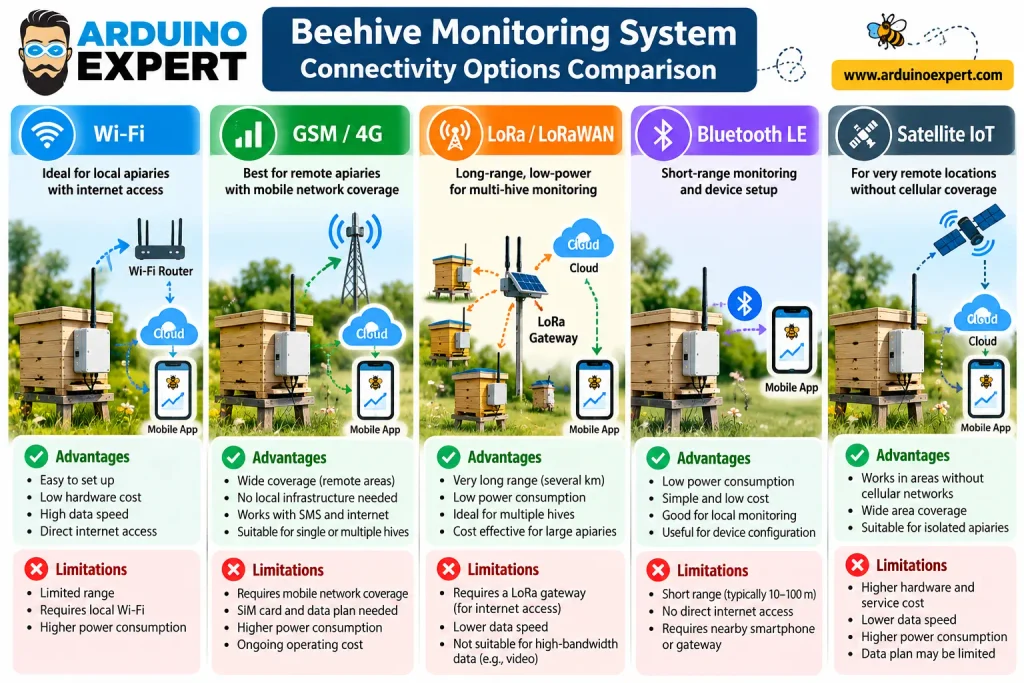
For commercial installations, the communication technology should be tested at the actual apiary before large-scale deployment.
Cloud-Based Beehive Monitoring Systems
A cloud-based beehive monitoring system allows readings collected from remote hives to be stored, processed, and accessed over the internet.
Instead of requiring the beekeeper to connect directly to each device, cloud platforms provide centralized access to monitoring information.
Cloud Platform Options
Popular options for developing IoT monitoring applications include:
- Blynk IoT
- ThingsBoard
- ThingSpeak
- AWS IoT Core
- Microsoft Azure IoT services
- Firebase-based custom applications
- MQTT-based self-hosted systems
- Custom cloud databases and dashboards
The best platform depends on the intended scale, data requirements, customization, security, and ongoing operating costs.
For a small prototype, an existing IoT dashboard platform may provide an efficient starting point.
A commercial apiary management product may require a custom cloud architecture with device authentication, user accounts, historical storage, subscription management, and administrative controls.

Important Cloud Features
A well-designed platform may support:
- Live and recent sensor readings
- Historical measurements
- Daily and seasonal trends
- Device connectivity status
- Multi-hive dashboards
- User permissions
- Notifications
- Data export
- Remote configuration
- Device diagnostics
- Firmware update management
MQTT and HTTPS are commonly used for IoT data communication.
Commercial systems should use secure authentication, encrypted connections where supported, appropriate access control, and reliable handling of temporary network failures.
Local data buffering is also useful. If the internet connection becomes unavailable, the device can store measurements and upload them after connectivity returns.
Mobile App-Based Beehive Monitoring
A beehive monitoring app makes smart beekeeping technology easier to use.
Instead of reading raw sensor data, a beekeeper can view the condition of multiple hives through a smartphone.
A mobile app may be developed for Android, iOS, or both.

Essential Features of a Beehive Monitoring App
Hive overview: Display current weight, temperature, humidity, last update time, and system status.
Historical charts: Compare measurements over different days, weeks, and seasons.
Multiple hive management: Monitor several colonies from one account.
Apiary grouping: Organize hives according to location, owner, or operational requirements.
Notification center: View warnings about unusual readings, possible disturbances, device faults, or low battery conditions.
Hive records: Maintain inspection notes, queen history, feeding records, treatment records, and harvest information.
Data export: Download readings for research, reporting, or external analysis.
Device settings: Configure reporting intervals, alert thresholds, and other supported options.
Custom Mobile Applications vs Ready-Made Platforms
A ready-made IoT application may be sufficient for a small project.
However, commercial monitoring systems often benefit from custom software that reflects the requirements of professional beekeepers.
A custom application can integrate colony inspection records, sensor data, apiary locations, inventory, notifications, and operational reporting.
At Arduino Expert, we provide Custom Mobile App Development Services for IoT and Smart Devices, including connected hardware integration, monitoring dashboards, and Android or iOS application development.
You can also read our guide on Mobile Phone Application Development for IoT, Arduino, ESP32, and Smart Devices to understand how connected hardware communicates with modern applications.
Solar-Powered and Battery-Powered Beehive Monitoring
Many beehives are installed in remote farms, forests, orchards, and mountainous areas where reliable electrical power is unavailable.
Therefore, power management is a major consideration in IoT beehive monitoring.
Available Power Options
Battery-powered monitoring: Suitable for low-power systems that take readings periodically.
Solar-powered monitoring: Combines a solar panel, rechargeable battery, and appropriate charge controller.
External DC power: Suitable when a reliable wired supply is available.
Hybrid power: Uses solar energy with battery storage and potentially an external backup supply.
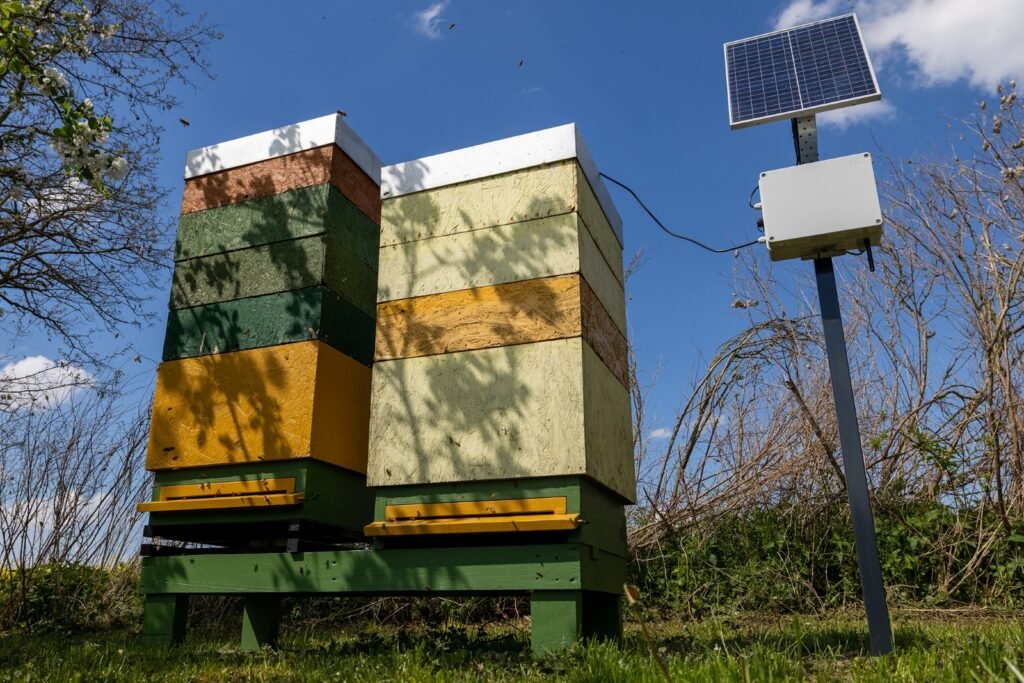
Typical Solar-Powered System Components
A solar-powered system may include a solar panel, rechargeable battery, charge controller, voltage regulator, protection circuitry, battery monitoring sensor, and low-power electronics.
Lithium-ion, LiFePO₄, and other battery technologies may be used depending on operating conditions and safety requirements.
The battery and charger must be compatible with the selected chemistry.
How to Reduce Power Consumption
Low-power firmware can significantly extend operating time by:
- Using sleep modes between measurements
- Reducing unnecessary transmissions
- Powering sensors only when required
- Sending grouped data packets
- Avoiding continuous high-power processing
- Monitoring battery voltage
- Adjusting reporting frequency where appropriate
Battery capacity and solar panel size should be selected using actual energy consumption, expected sunlight, winter conditions, operating temperature, and backup-day requirements.
A device that transmits every few minutes can have very different power requirements from one that uploads data twice per day.
The power system should be designed for the least favorable expected operating conditions rather than an ideal sunny day.
AI and Machine Learning in Smart Beekeeping
Artificial intelligence is an emerging area of smart beehive monitoring and precision beekeeping.
Traditional systems primarily collect measurements and compare them with configured limits.
AI-enabled systems attempt to identify more complex relationships between historical sensor readings, environmental conditions, and colony behavior.

AI-Based Monitoring Applications
Swarm-risk analysis: Analyze combinations of weight trends, acoustic features, weather, and activity measurements to identify patterns associated with possible swarming.
Colony activity classification: Use entrance counters, audio features, and environmental information to estimate changes in colony activity.
Temperature anomaly detection: Identify unexpected changes in thermal patterns relative to the colony’s historical behavior.
Predictive weight analysis: Estimate seasonal resource accumulation or consumption based on historical measurements.
Computer vision: Analyze entrance activity, bee movement, and image-based indicators.
Acoustic pattern recognition: Use signal processing and machine learning to identify characteristic sound patterns.
Potential disease or pest indicators: Investigate patterns associated with health concerns, while recognizing that reliable diagnosis usually requires additional evidence and physical examination.
Limitations of AI Beehive Monitoring
AI models require representative training data, appropriate validation, and reliable sensors.
A model trained using one hive type, climate, or bee population may not perform equally well in other conditions.
False alarms and missed events are possible.
Consequently, AI should be considered a decision-support tool rather than a guaranteed method for diagnosing disease, detecting queenlessness, or predicting swarming.
Beehive Monitoring for Honey Production and Harvest Planning
One of the most commercially useful applications of monitoring technology is tracking hive weight.
A connected hive scale provides a time series that can be compared with weather conditions, nectar flows, and management activities.
For example, sustained weight increases over several days may indicate strong resource collection.
A beekeeper can use that information alongside physical frame inspections to make better harvest-planning decisions.
Historical measurements can also help compare apiary locations.
However, a hive scale cannot directly determine honey moisture content, honey ripeness, or the exact quantity of harvestable honey.
Those decisions still require appropriate beekeeper assessment.
Weight monitoring is most effective when combined with inspection records, seasonal context, and local knowledge.
Smart Beehive Monitoring for Commercial Apiaries
A commercial operation may manage dozens, hundreds, or even more colonies across multiple locations.
Installing a standalone monitoring device on every hive can become expensive and difficult to manage.
For larger deployments, a multi-hive apiary monitoring system may be more practical.
Multi-Hive Monitoring Architecture
Each selected hive contains a sensor node that measures relevant parameters.
Nodes transmit information to a shared gateway or cloud-connected communication system.
The software identifies each hive using a unique device ID.
A centralized dashboard allows users to compare hives across different sites.
Possible features include:
- Apiary-level dashboards
- Individual hive records
- Weight and temperature comparisons
- Group alerts
- Map-based hive locations
- Device battery monitoring
- Gateway health monitoring
- Historical performance analysis
- User roles and access management
- Exportable operational reports
Not every colony must necessarily have the same sensor configuration.
For example, an apiary may use weight scales on representative hives while employing lower-cost temperature sensors on a larger number of colonies.
This approach can reduce total implementation cost while still providing useful monitoring information.
For systems deployed across large farms, LoRa-connected nodes with a cellular gateway can be an effective architecture when coverage and site conditions allow it.
DIY vs Commercial Beehive Monitoring Systems
Beekeepers can choose between building a custom monitoring device and purchasing an existing commercial solution.
Both approaches have benefits.
| Feature | DIY System | Commercial System |
| Initial hardware selection | Highly customizable | Usually predefined |
| Technical knowledge | Often required | Usually less required |
| Sensor options | Flexible | Product dependent |
| Mobile application | Custom or third-party | Often included or subscription-based |
| Calibration | User responsibility | Depends on product |
| Maintenance | User-managed | Vendor support may be available |
| Scaling | Requires system design | Depends on platform |
| Upfront cost | May be lower | Often higher |
| Long-term reliability | Depends on engineering | Depends on product quality |
| Product support | Community or developer | Vendor dependent |
When Is DIY Monitoring Suitable?
DIY beehive monitoring is useful for students, hobbyists, researchers, and developers who want to experiment with electronics or build a monitoring system around specific requirements.
For example, a simple Arduino-based hive scale can be an excellent introduction to load cells, sensors, and wireless communication.
When Is a Commercial System Better?
Commercial solutions may be preferable when the user wants an established product with installation guidance, a supported application, and maintenance options.
However, proprietary systems may impose limitations on sensor compatibility, data ownership, subscription costs, or customization.
What About Custom Professional Development?
Custom development provides a third option.
A beekeeper, startup, or agricultural technology business may need a solution that is not available as an off-the-shelf product.
This may involve specialized sensors, unique mounting structures, particular cloud services, custom apps, or a dedicated wireless network.
Arduino Expert offers Custom Smart Beehive Monitoring System Development Services for prototypes, research systems, and commercial IoT products.
How Much Does a Beehive Monitoring System Cost?
The cost of a beehive monitoring system depends on its complexity, accuracy, communication method, power requirements, and number of monitored hives.
A basic standalone monitoring device is substantially different from a commercial platform that combines load cells, cameras, cellular communication, solar power, and custom software.
Main Cost Factors
| Cost Category | What Affects Cost |
| Weight measurement | Load-cell capacity, quantity, accuracy, and mechanical frame |
| Environmental sensors | Sensor quality and number of measurement locations |
| Controller | Processing requirements and power consumption |
| Communication | Wi-Fi, cellular, LoRa, satellite, or wired connectivity |
| Power | Battery capacity, solar panel, and charging system |
| Enclosure | Outdoor durability and environmental protection |
| Cloud infrastructure | Data storage, processing, and device management |
| Mobile application | Standard platform or custom software |
| Installation | Mounting, calibration, and field testing |
| Maintenance | Repairs, subscriptions, battery replacement, and support |
As an illustrative market reference, standalone commercial temperature sensors may cost tens of US dollars, while connected hive scales can cost several hundred dollars. Complete monitoring packages and commercial deployments can cost considerably more.
Prices vary by supplier, region, connectivity service, and included features.
DIY systems may offer lower hardware costs, but design time, calibration, reliability testing, and maintenance must also be considered.
For commercial projects, calculate the total cost of ownership, not just the purchase price.
This includes recurring cloud fees, SIM data plans, replacement batteries, communication gateways, field visits, and long-term device support.
How to Choose the Best Beehive Monitoring System
There is no single monitoring solution that is ideal for every beekeeper.
The right system depends on the size and location of the apiary, monitoring goals, and available budget.
For Hobbyist Beekeepers
Start with useful core measurements, such as hive weight and temperature.
A simple dashboard or local display may be sufficient.
Avoid adding expensive sensors before identifying how their data will improve hive management.
For Remote Apiaries
Prioritize reliable communication, battery life, solar power, weather-resistant hardware, and data storage during communication outages.
Test cellular coverage or gateway placement before installation.
For Commercial Beekeepers
Look for centralized hive management, historical trends, multiple user accounts, alerts, maintenance support, and scalable connectivity.
For Researchers
Evaluate sensor accuracy, calibration, sampling frequency, time synchronization, data export, and reproducibility.
For IoT Product Developers
Consider hardware lifecycle, PCB design, enclosure manufacturing, firmware updates, cybersecurity, regulatory requirements, and scalability.
A monitoring system should be selected for its ability to answer useful management questions—not simply because it includes the largest number of sensors.
How to Develop a Custom Beehive Monitoring System
Developing a dependable system involves more than connecting sensors to a microcontroller.
A professional development process should include the following stages.
Step 1: Define the Monitoring Objectives
Identify which measurements are needed and what decisions the system should support.
For example, a hive scale focused on honey-flow monitoring may not require audio processing or cameras.
Step 2: Select Appropriate Sensors
Choose sensors based on expected measurement range, accuracy, environmental durability, and installation requirements.
Step 3: Select the Processing Hardware
Choose a microcontroller, single-board computer, or custom embedded system suitable for the application.
Step 4: Plan Communication
Determine whether Wi-Fi, cellular, LoRa, or another communication method is appropriate.
Step 5: Design the Power System
Estimate power requirements and select a battery, solar system, or external power supply.
Step 6: Develop the Firmware
Program sensor acquisition, calibration, data processing, storage, communication, diagnostics, and power management.
Step 7: Develop the Dashboard or Mobile App
Build software for visualization, alerts, historical records, and device management.
Step 8: Design the Enclosure and Mechanical Components
Protect the electronics against rain, humidity, insects, UV exposure, and mechanical damage.
Ensure the scale installation does not obstruct hive access or normal bee activity.
Step 9: Calibrate and Test the System
Test sensors using reference measurements. Evaluate communication performance, battery life, and environmental durability.
Step 10: Deploy and Maintain the System
Install the devices, verify data quality, configure alerts, and establish a maintenance schedule.
Periodic recalibration and inspection of equipment may be necessary.
Real-World Beehive Monitoring Projects by Arduino Expert
At Arduino Expert, we have developed practical monitoring projects that demonstrate how electronics, sensors, wireless communication, and cloud platforms can be applied to beekeeping.
Project 1: IoT Smart Beehive Monitoring System with ESP32 and SIM800L
This project demonstrates a cloud-connected beehive monitoring solution designed for a remote monitoring application.
The system includes:
- ESP32-based controller with SIM800L GSM connectivity
- Load-cell weight measurement
- Temperature and humidity sensing
- HX711 load-cell interface
- Local LCD display
- Blynk IoT cloud dashboard
- Periodic GSM data uploads
- Scheduled SMS updates
- Alert functionality for unusual changes
The published implementation includes hourly cloud reporting, sunrise and sunset SMS updates, and monitoring of weight, temperature, and humidity.
It demonstrates how conventional sensors can be integrated with a cloud platform to create a practical remote monitoring solution.
Read the complete project: IoT Smart Beehive Monitoring System – Weight Scale with ESP32, SIM800L, and DHT22.
Project 2: IoT Bee Hive Weight Scale with Arduino
This project demonstrates a simpler electronic hive monitoring approach.
It uses an Arduino controller, load cell, HX711 module, temperature and humidity sensor, and SIM800L GSM module.
Measurements can be displayed locally and sent through SMS, with optional internet-based monitoring.
This project is especially useful for readers who want to understand the basic working principles of an electronic hive scale and SMS monitoring system.
Explore the project: IoT Bee Hive Weight Scale with Arduino and SIM800L.
Custom Beehive Monitoring System Development
Every apiary has different operational requirements. Some beekeepers need only remote weight measurement. Others require complete monitoring systems involving solar power, multiple sensors, mobile applications, or long-range wireless networks.
Arduino Expert provides custom development services covering hardware design, sensor integration, embedded firmware, wireless connectivity, PCB design, cloud platforms, dashboards, and mobile applications.
Whether you need a university research prototype, a custom electronic scale, or a connected monitoring solution for commercial beekeeping, our development services can be tailored to the required features and operating environment.
Challenges and Limitations of IoT Beehive Monitoring
Although smart hive monitoring offers important benefits, outdoor systems face several challenges.
Sensor Accuracy and Calibration
Load cells may experience drift, mounting errors, or temperature effects. Environmental sensors can be affected by moisture, dirt, or poor positioning.
Regular verification is important.
Internet Connectivity
Remote apiaries may experience weak signals or temporary communication failures.
Local buffering and retry mechanisms can help prevent data loss.
Power Consumption
Continuous communication, high-frequency sampling, and camera processing can significantly increase energy requirements.
Environmental Durability
Devices must withstand rain, sunlight, dust, temperature variation, and insects.
Outdoor electronics require suitable sealing while still allowing sensors to measure their intended environment.
False Alarms
A sudden weight change may be caused by harvesting, equipment movement, wind, or other normal activities.
Alert logic should consider multiple measurements and historical patterns wherever possible.
Maintenance Requirements
Even advanced monitoring devices require periodic battery replacement, inspection, cleaning, calibration, and software maintenance.
Data Security
Connected systems need appropriate protection against unauthorized access, device impersonation, credential exposure, and insecure communications.
Limits of Automated Interpretation
Monitoring data provides indicators, not guaranteed biological diagnoses.
A monitoring system cannot replace inspections for queen status, brood condition, disease assessment, food stores, or treatment decisions.
The greatest value comes from combining sensor data with experienced beekeeper observations.
Future of Beehive Monitoring and Precision Beekeeping
Smart beekeeping technology is likely to evolve as sensors, wireless networks, and machine learning systems continue improving.
Several development areas are particularly interesting.
More Efficient Wireless Monitoring
Low-power networks may allow larger apiaries to connect many sensors while reducing battery replacements and communication costs.
Advanced AI Analytics
Research into acoustic, visual, environmental, and weight-based analysis may improve the ability to identify unusual colony conditions.
Improved Bee Activity Monitoring
Computer vision and specialized entrance counters may provide more detailed observations of foraging patterns and colony traffic.
Predictive Apiary Management
Combining historical hive data, weather forecasts, inspection records, and seasonal patterns could help beekeepers plan management activities.
Integrated Beekeeping Platforms
Future applications may combine sensor monitoring with inspection management, honey harvesting records, inventory tracking, treatment documentation, and apiary mapping.
Custom IoT Monitoring Products
As connectivity and embedded technologies evolve, companies may develop increasingly specialized monitoring products for different climates, hive types, and management practices.
The most useful innovations will be those that provide dependable information, remain affordable to maintain, and solve real problems for beekeepers.
Conclusion: The Future of Beekeeping Is Connected
A beehive monitoring system provides a practical way to combine traditional beekeeping knowledge with modern IoT technology.
By using smart sensors, electronic hive scales, wireless communication, cloud dashboards, and mobile applications, beekeepers can gain greater visibility into their colonies and respond more effectively to changing conditions.
From simple weight-monitoring devices to advanced AI-assisted multi-hive networks, smart beekeeping solutions can be adapted to different budgets, environments, and operational needs.
However, successful monitoring requires more than adding sensors. Accurate measurements, reliable connectivity, appropriate power management, durable hardware, and sensible data interpretation are essential.
Whether you are a hobbyist exploring digital hive scales, a commercial beekeeper managing remote apiaries, or an agricultural technology company developing a new product, choosing the right monitoring architecture is the first step.
Need a Custom IoT Beehive Monitoring System?
At Arduino Expert, we provide custom beehive monitoring development services, including:
- Smart beehive weight monitoring
- Temperature and humidity monitoring
- GSM, 4G, Wi-Fi, and LoRa connectivity
- Solar-powered monitoring systems
- Multi-hive sensor networks
- Cloud dashboards and data logging
- Android and iOS mobile applications
- SMS, email, and app-based alerts
- Custom PCB design and embedded firmware
- Research prototypes and commercial IoT product development
From a basic electronic hive scale to a complete smart apiary monitoring platform, we can help develop a solution based on your requirements.
Explore Our Beehive Monitoring System Development Services
Frequently Asked Questions About Beehive Monitoring Systems
What is a beehive monitoring system?
A beehive monitoring system is an electronic system that collects information about hive conditions using sensors. It may monitor weight, temperature, humidity, activity, movement, and other parameters, with optional remote access through a mobile app or cloud platform.
How does an IoT beehive monitoring system work?
Sensors collect hive measurements. An embedded controller processes the data and sends it through a communication network to a dashboard, server, or mobile application. The system may also issue alerts when unusual conditions are detected.
What are the most important sensors for smart beekeeping?
Weight, temperature, and humidity sensors are useful starting points. Advanced systems may also include acoustic sensors, entrance counters, motion detectors, GPS, and environmental sensors.
Can I monitor my beehive remotely without Wi-Fi?
Yes. Cellular communication, LoRa-based networks with connected gateways, and certain other remote communication technologies can support monitoring without local Wi-Fi.
Can a beehive monitoring system detect swarming?
A system may identify weight, sound, or activity patterns associated with possible swarming. However, reliable confirmation requires additional observations, and false alarms are possible.
Can a smart hive scale measure honey production?
A digital hive scale measures total hive weight. Changes can provide useful insights into resource collection and honey-flow trends, but they do not directly measure the exact quantity of honey produced or ready for harvesting.
Can I monitor several beehives from one mobile application?
Yes. Multi-hive monitoring platforms can organize sensor readings from different hives and apiaries in one centralized dashboard.
Can a beehive monitoring system operate on solar power?
Yes. Solar panels combined with rechargeable batteries and suitable charging electronics are commonly considered for remote monitoring installations. System sizing depends on power consumption and available sunlight.
Is artificial intelligence necessary for beehive monitoring?
No. Many useful systems operate using straightforward measurements and configurable alerts. AI is an optional feature for more advanced analysis.
Can beehive monitoring systems work offline?
Yes. Some systems display and store data locally. Others use gateway storage and upload measurements when connectivity returns. Remote access requires an available communication path.
What is the best wireless technology for a remote apiary?
The answer depends on the site. Cellular connectivity may be suitable where mobile coverage is reliable, while LoRa can be effective for connecting several sensor nodes to a central gateway. Both options require proper field testing.
How much does a smart beehive monitoring system cost?
Costs depend on the sensor package, weight measurement hardware, communication technology, power system, software, and installation requirements. A simple DIY monitor may cost considerably less than a complete commercial multi-hive monitoring platform.
Do smart beehive monitoring systems replace manual inspections?
No. They provide valuable information between inspections, but colony management still requires physical examinations and appropriate beekeeper judgment.
Can a custom beehive monitoring system be developed for commercial use?
Yes. Custom systems can be developed with specific sensors, wireless communication methods, cloud dashboards, mobile applications, weather-resistant electronics, and scalable architectures.