
Complete Arduino Course in Urdu/Hindi | Learn Arduino Programming

Uncategorized
Wishlist Share

About Course

This Arduino course is a complete beginner-to-intermediate guide in Urdu/Hindi, designed to help you learn electronics and programming from scratch. You will start with the basics of Arduino setup, coding, and circuit building, then gradually move toward working with sensors, displays, motors, and real-world projects. By the end of the course, you will be able to design, build, and program your own Arduino-based systems with confidence, even if you have no prior experience. 

یہ آرڈوینو کورس اردو اور ہندی زبان میں بنیادی/انٹرمیڈیٹ لیول تکت ایک مکمل گائیڈ ہے، جسے اس طرح ڈیزائن کیا گیا ہے کہ آپ الیکٹرانکس اور پروگرامنگ کو بالکل ابتدا سے سیکھ سکیں۔ آپ آرڈوینو کی سیٹ اَپ، کوڈنگ، اور سرکٹ بنانے کی بنیادی باتوں سے آغاز کریں گے، پھر آہستہ آہستہ سینسرز، ڈسپلے، موٹرز، اور حقیقی دنیا کے عملی پروجیکٹس پر کام کرنا سیکھیں گے۔ اس کورس کے اختتام تک آپ اعتماد کے ساتھ اپنے آرڈوینو پر مبنی سسٹمز کو ڈیزائن، تیار، اور پروگرام کرنے کے قابل ہو جائیں گے، چاہے آپ کے پاس پہلے سے کوئی تجربہ نہ بھی ہو۔
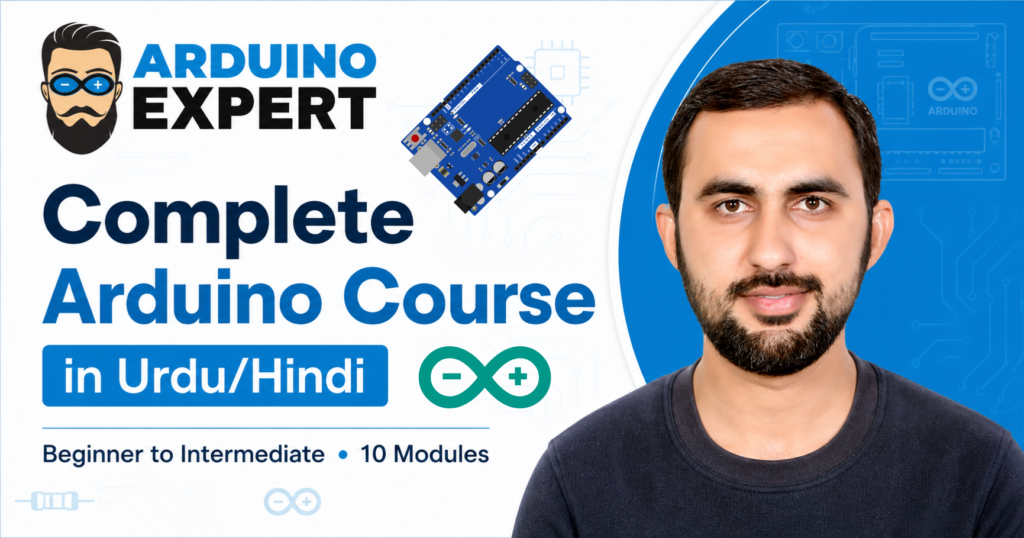
Complete Arduino Course in Urdu Hindi Learn Arduino Programming and Projects

For more courses you can checkout our Courses page. For any other information you can contact us at WhatsApp or our Services page.

Show More

What Will You Learn?

  • Understand the fundamentals of Arduino and basic electronics
  • Install and use the Arduino IDE for writing and uploading code
  • Learn Arduino programming (variables, loops, conditions, functions)
  • Build and test circuits using LEDs, resistors, and push buttons
  • Work with analog and digital inputs and outputs
  • Interface sensors like temperature, distance, and light sensors
  • Control actuators such as LEDs, buzzers, and motors
  • Use displays (LCD/Serial Monitor) to show data
  • Implement PWM and timing functions for advanced control
  • Build real-world Arduino projects step by step
  • Debug and troubleshoot hardware and code issues
  • Gain confidence to design your own Arduino-based systems

Course Content

Module 1 — Introduction & Development Environment
Core Topics Covered What is Arduino: boards, hardware overview, pinout Installing & setting up the Arduino IDE Writing and uploading your first sketch Program structure: setup() and loop() Basic debugging and Serial Monitor Purpose: Bring absolute beginners up to speed on tools, hardware, software, and first code

  • Lesson 1: Getting Started with Arduino
    18:20

Module 2 — Digital I/O and Basic Electronics
Core Topics Covered Digital output: LEDs, digitalWrite/digitalRead Understanding resistors, breadboards and circuits Pushbuttons and simple inputs Pull-up vs pull-down resistors Purpose: Fundamental digital interfacing skills with basic physical components.

Module 3 — Programming Fundamentals in Arduino C++
Core Topics Covered Variables and data types Operators (arithmetic, relational, logical) Control structures: if, else, switch Loops: for, while, do…while Functions and code structure Scope and constants Purpose: Provide learners with solid software fundamentals specific to microcontroller coding.

Module 4 — Timing, PWM, and Analog Interfacing
Core Topics Covered delay() vs non-blocking timing (millis()) PWM and analogWrite Reading analog values with analogRead Using potentiometers and sensors with analog signals Purpose: Teach how to work with analogue signals and timed control—essential for real projects.

Module 5 — Displays and Output Devices
Core Topics Covered Serial Monitor and debugging LCD displays (e.g., 16×2 or I2C) Controlling multiple outputs to create meaningful feedback Purpose: Enable users to visualize information and understand output interfaces beyond LEDs.

Module 6 — Sensors and Data Acquisition
Core Topics Covered Ultrasonic distance sensors (HC-SR04) Light sensors, temperature sensors (e.g., DHT11 / photoresistors) Serial Plotter for visualizing data Purpose: Introduce real world sensing and real-time data interpretation.

Module 7 — Motors and Actuators
Core Topics Covered DC motor basics and control Servo motors control Stepper motors introduction Purpose: Show how to control motion—key for robots, mechatronic projects, and automation.

Module 8 — Communication Interfaces
Core Topics Covered Serial communication fundamentals I2C basics (for sensors/displays) Simple wireless: IR remote control and receiver decoding Purpose: Expand beyond local sensors to interfacing and communication.

Module 9 — Intermediate Projects
Core Topics Covered Counters and logic flows Using shift registers (74HC595) Combining inputs and displays (e.g., keypad + LCD) Project example: digital counter or menu system Purpose: Integrate previously learned skills into non-trivial, project-like workflows.

Module 10 — Capstone Projects and Best Practices
Core Topics Covered Full project examples (multi-component systems) Power considerations and circuit robustness Debugging strategies and code organization Next steps beyond basics (libraries, advanced boards, IoT) Purpose: Cement learning with larger projects, real-world concerns, and future pathways.

Student Ratings & Reviews

No Review Yet

No Review Yet
Facebook
YouTube