The RFID-based Sequential Access System with Arduino and Audio Playback is a custom electronics project development solution designed and implemented by ArduinoExpert as part of our Product Design and Development and Embedded Systems Development services. This system introduces an advanced layer of security by enforcing order-based RFID authentication, ensuring that access is granted only when authorized RFID cards are scanned in a predefined sequence.
Unlike traditional RFID access systems that rely on single-card authentication, this Arduino project validates multiple RFID tags in a strict sequence. Each successful step provides audio and visual feedback, guiding the user through the process. Upon successful completion of the sequence, the system activates a relay to control external devices such as door locks, motors, or industrial loads.
This project demonstrates our expertise in Arduino-based product development, custom embedded firmware design, and intelligent access control systems tailored to client-specific requirements. You can also explore our advance UHF RFID door lock security system with ATmega328p Microcontroller.

Working Principle of RFID-based Sequential Access System
The system operates on a sequential authentication logic, ensuring strict order-based access:
- The system initializes and waits for the first authorized RFID card.
- When a valid card is scanned using the MFRC522 RFID reader, the Arduino verifies:
- Whether the card is authorized
- Whether it matches the expected position in the sequence
- If correct:
- A corresponding MP3 audio message is played via the DFPlayer Mini
- A specific status LED is activated
- The system advances to the next authentication step
- An RGB LED provides real-time visual feedback:
- Green: Correct card scanned
- Blue: System active / waiting
- Red: Error or invalid card
- Once all RFID cards are scanned in the correct order:
- The relay module is activated for a predefined duration
- An external device (lock, motor, or electrical load) is triggered
- The system then automatically resets and waits for the first card again
If an incorrect card is scanned at any point, the system:
- Plays an error audio message
- Activates the red indicator
- Resets the sequence immediately, enforcing strict security
Key Features of Arduino RFID Sequential Access Control System
- Sequential RFID authentication (order-based validation)
- Audio feedback using DFPlayer Mini MP3 module
- Visual indication using RGB LED and multiple status LEDs
- Relay control after successful authentication sequence
- Automatic system reset on wrong card detection
- Serial monitoring for debugging and diagnostics
- Scalable logic for adding more RFID cards or steps
Components Used in RFID-based Sequential Access System
Arduino Uno (or compatible microcontroller)
- MFRC522 RFID Reader
- DFPlayer Mini MP3 Module with SD Card
- RGB LED and multiple indicator LEDs
- Relay module
- RFID cards or tags
- Power supply and supporting circuitry
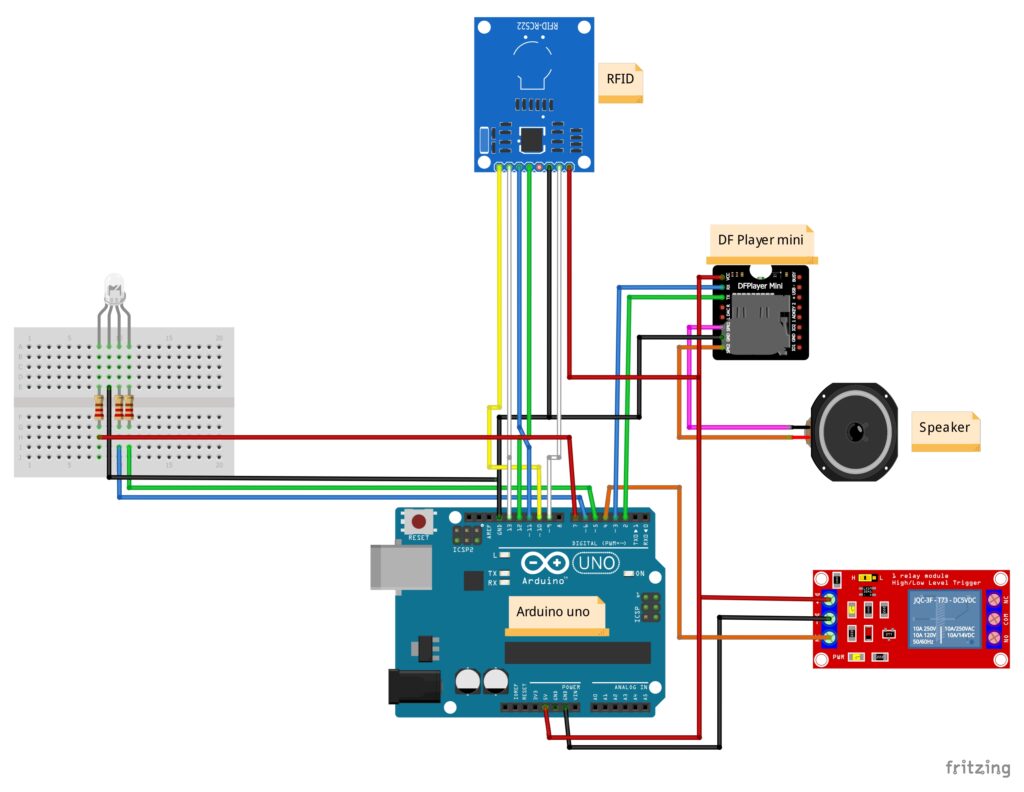
Circuit Diagram of Arduino with RFID and DFPlayer Mini
Embedded Systems & Firmware Design
The Arduino Code/firmware is developed using the Arduino IDE, following best practices in embedded systems development:
- Modular code structure for scalability
- Secure RFID UID handling
- Non-blocking audio playback logic
- Robust error handling and system reset logic
- Serial output for testing and debugging
This approach ensures reliability, maintainability, and easy customization for future enhancements.
Arduino Code for RFID Order-Based Authentication System
#include <SPI.h>
  #include <MFRC522.h>
  #include "SoftwareSerial.h"
  #include "DFRobotDFPlayerMini.h"

  SoftwareSerial mySoftwareSerial(2, 3); // RX, TX
  DFRobotDFPlayerMini myDFPlayer;

  #define SS_PIN 10
  #define RST_PIN 9
  MFRC522 mfrc522(SS_PIN, RST_PIN);   // Create MFRC522 instance.

  String ID1 = "E3 45 06 2E";
  String ID2 = "01 BA 73 26";
  String ID3 = "EE 01 43 B3";
  String ID4 = "EE 01 43 B3";
  String ID5 = "EE 01 43 B3";
  String ID6 = "EE 01 43 B3";

  const int PIN_GREEN = 5;
  const int PIN_BLUE  = 6;
  const int PIN_RED  = 7;

  int LED[7] = {8, A0, A1, A2, A3, A4, A5};

  int Relay = 4;
  int Card_Nmbr = 1;

  void setup()
  {
    Serial.begin(9600);   // Initiate a serial communication
    mySoftwareSerial.begin(9600);
    pinMode(Relay, OUTPUT);
    pinMode(PIN_GREEN, OUTPUT);
    pinMode(PIN_BLUE,  OUTPUT);
    pinMode(PIN_RED,  OUTPUT);
    for (int i=1; i<=6; i++)
    {pinMode(LED[i], OUTPUT);}

    SPI.begin();      // Initiate  SPI bus
    mfrc522.PCD_Init();   // Initiate MFRC522
    Serial.println("Approximate your card to the reader...");
    Serial.println();

    Initialize_DF_Player();
    digitalWrite(Relay, HIGH); //Keep Relay OFF at Start
  }
  void loop()
  {
Our Related Development Services
At arduinoexpert.com, we specialize in transforming ideas into functional, production-ready solutions. This project highlights our capabilities in:
- Custom Electronics Project Development for security applications
- Embedded Systems Development using Arduino platforms
- Product Design and Development for real-world automation and control systems
- Prototype-to-Deployment IoT and Automation Solutions
Projects like this are commonly requested by clients looking for custom access control, automation logic, or interactive embedded systems beyond off-the-shelf products.
Applications of Smart RFID-Based Multi-Step Access System
This RFID-based Arduino project can be customized for multiple real-world applications:
- Secure access control systems
- Puzzle-based security and escape room automation
- Multi-step authentication for restricted environments
- Educational demonstrations of RFID and embedded systems
- Industrial automation requiring ordered authorization
- Smart locks and interactive installations
Checkout Our Related Project: PC Access Control with RFID and Arduino
Future Customization & Product Development Possibilities
As part of our Product Design and Development services, this system can be enhanced with:
- IoT-based remote monitoring (Wi-Fi / GSM / Ethernet)
- Mobile app or web dashboard integration
- Encrypted RFID authentication
- EEPROM-based dynamic card management
- Touchscreen or keypad-based hybrid authentication
- Industrial-grade enclosures and PCB design
Conclusion
The RFID-based Sequential Access System with Arduino and Audio Playback is a powerful example of how custom embedded systems development can significantly enhance security and user interaction. Designed and developed by ArduinoExpert, this project reflects our strong capabilities in Arduino project development, custom electronics design, and product engineering services.
If you are looking for a custom RFID solution, Arduino-based automation system, or a complete product design and development partner, ArduinoExpert is ready to help you bring your idea to life.
Need Help/Assistance in Custom RFID Access Control Arduino Project?
If you need this Smart Magnet Control System Project with or without Modifications or Customization then you can contact us through WhatsApp. We can also provide you Zoom Assistant.
If you are Interested in a similar custom solution? Explore our Embedded Systems Development and Arduino Project Development services.
Frequently Asked Questions (FAQs)
1. What is an RFID-based sequential access system?
An RFID-based sequential access system is an advanced access control solution where multiple RFID cards must be scanned in a predefined order to grant access. Unlike standard RFID systems, this approach adds an extra layer of security by enforcing order-based authentication, making it ideal for custom electronics project development and high-security embedded applications.
2. How does this Arduino RFID project improve security compared to normal RFID systems?
Traditional RFID access systems authenticate a single card, whereas this Arduino project requires multiple authorized RFID cards to be scanned sequentially. If the order is broken or an invalid card is detected, the system resets immediately. This makes it highly suitable for secure embedded systems development and controlled-access environments.
3. Can this RFID sequential access system be customized for specific client requirements?
Yes. As part of our Product Design and Development and Custom Electronics Project Development services, this system can be fully customized. Options include adding more RFID steps, integrating IoT connectivity, mobile apps, encrypted authentication, custom enclosures, and PCB design for production-ready deployment.
4. Which industries or applications commonly use sequential RFID access systems?
This type of system is commonly used in secure access control, escape rooms, industrial automation, educational demonstrations, puzzle-based security systems, and multi-step authorization workflows. It is especially popular in custom embedded systems development projects where standard solutions are insufficient.
5. Is this project suitable for commercial or industrial deployment?
Absolutely. With proper PCB design, industrial-grade components, and enclosure development, this system can be converted into a production-ready embedded product. ArduinoExpert provides complete product engineering and embedded systems development support for such deployments.
6. Can this RFID system be integrated with IoT or cloud platforms?
Yes. The system can be upgraded with ESP32, ESP8266, GSM, or Ethernet modules to enable cloud connectivity, remote monitoring, and logging. This aligns well with our IoT product development and smart systems integration services.
7. Is the RFID card sequence fixed or changeable?
The sequence can be fixed in firmware or made configurable using EEPROM, admin cards, or a software interface. This flexibility is part of our custom firmware development approach for embedded systems.