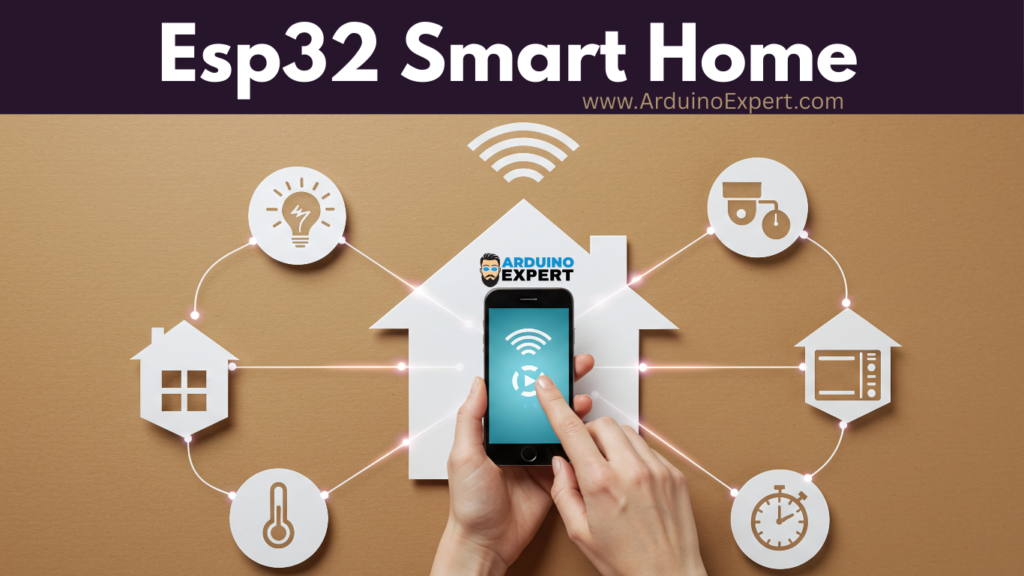
With the rapid growth of IoT (Internet of Things) technologies, traditional homes are transforming into intelligent, connected smart environments. Modern users now expect remote monitoring, automation, safety alerts, and energy-efficient control of household appliances from anywhere in the world. This demand has significantly increased the need for ESP32-based Home Automation solutions. This project demonstrates a feature-rich ESP32-based Smart Home Automation System designed as part of professional Product Design and Development and Smart Systems Services. The system integrates multiple environmental and safety sensors with the Blynk IoT platform, enabling real-time monitoring, automation, and remote control of home appliances through a mobile application.
The solution showcases how modern ESP32 IoT technology can be used to build intelligent, scalable, and energy-efficient IoT-enabled home automation systems. All sensor data is displayed both on a Blynk mobile dashboard and a local I2C LCD, while appliances can be controlled in Auto Mode or Manual Mode directly from the app.
This project is ideal for ESP32 Home Automation, Arduino/ESP32 IoT Projects, and commercial Home Automation Services where reliability, flexibility, and remote accessibility are critical.
Key Features of the Smart Home Automation System Project
- Wi-Fi-Enabled ESP32 IoT Controller
- Remote Control & Monitoring via Blynk App
- Auto Mode & Manual Mode Switching
- Real-Time Sensor Data Visualization
- Local Monitoring via I2C LCD
- Relay-Based High-Voltage Appliance Control
- Safety & Environmental Monitoring
Working Principle of Smart Home Automation System
The ESP32 microcontroller acts as the central processing unit of the system. It collects data from multiple sensors, processes the logic for automation, and communicates with the Blynk IoT cloud over Wi-Fi. Based on sensor readings and user-defined thresholds, the ESP32 controls relays connected to various appliances.
Users can override automatic behavior using manual buttons in the Blynk app, making the system flexible for real-world smart home usage.
Temperature & Humidity-Based Fan Control (DHT11/12 Sensor)
The DHT12 temperature and humidity sensor is used to continuously monitor ambient conditions.
Functionality:
- Reads real-time temperature and humidity
- Displays values on:
- Blynk mobile app
- I2C LCD
- Automatically controls two fans connected to a 2-channel relay module
Automation Logic:
- When temperature exceeds a predefined threshold:
- Fan 1 or Fan 2 turns ON automatically
- When temperature drops below the set value:
- Fans turn OFF
- Users can switch between:
- Auto Mode (sensor-based control)
- Manual Mode (Blynk buttons)
This feature demonstrates intelligent climate control, making it suitable for ESP32 IoT Smart Systems Services. If you want to check our ESP32 Based Water Heater Temperature Control System Project then please Visit this Page.
Motion-Based Light Control Using PIR Sensor
A PIR (Passive Infrared) motion sensor is connected to the ESP32 for smart lighting control.
Functionality:
- Detects human motion in the room
- Automatically turns light ON when motion is detected
- Turns light OFF after a defined inactivity period
- Light is connected via a relay module
Control Options:
- Automatic motion-based operation
- Manual ON/OFF control from the Blynk app
This feature enhances energy efficiency and is a core component of modern ESP32 Home Automation systems.
If you want to turn on your room light with just a clap then please visit this Project.
Automatic Water Pump Control Using Ultrasonic Sensor (HC-SR04)
The HC-SR04 ultrasonic sensor is used for water level monitoring.
Functionality:
- Measures distance to detect water level in a tank
- Controls a water pump via relay
- Prevents:
- Dry running
- Water overflow
Automation Logic:
- Low water level → Pump ON
- Tank full → Pump OFF
- Water level data displayed on:
- Blynk app
- I2C LCD
Manual pump control is also available through the Blynk interface, making this feature ideal for Smart Systems Services and IoT-based utility automation.
If you want to check our ESP32 Based Water Pump Automation Project with Blynk then please Visit this Page.
Gas / Smoke Detection & Buzzer Alert Using MQ Sensor
An MQ series gas/smoke sensor is used for safety monitoring.
Functionality:
- Continuously monitors air quality
- Detects gas or smoke concentration
- Activates buzzer automatically when threshold exceeds safe limits
Safety Features:
- Real-time gas level display on Blynk and LCD
- Immediate audible alert via buzzer
- Manual buzzer control from the Blynk app if required
This module highlights IoT-based safety automation, suitable for residential and industrial applications.
Dual Display System: Blynk App & I2C LCD
Blynk Mobile App:
- Real-time sensor data visualization
- Virtual buttons for:
- Fans
- Lights
- Water pump
- Buzzer
- Auto/Manual mode selection
- Cloud-based remote access from anywhere
I2C LCD Display:
- Local real-time display of:
- Temperature
- Humidity
- Water level
- Gas sensor values
- Useful during internet outages or maintenance
Relay Control & Electrical Safety
- 2-Channel Relay Modules used for:
- Fans
- Light bulb
- Water pump
- ESP32 provides low-voltage control
- Relays safely switch high-voltage AC appliances
- Ensures isolation and protection of the microcontroller
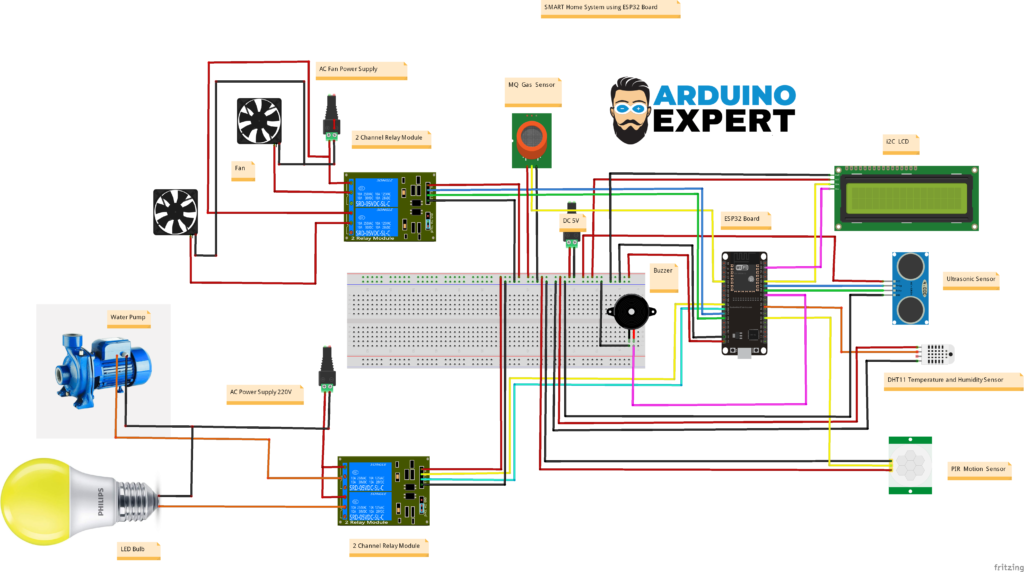
Circuit Diagram of ESP32 with PIR, DHT22, Ultrasonic, MQ Gas Sensor, Relay Modules, Buzzer and LCD
The circuit diagram represents a centralized IoT control system where the ESP32 acts as the master controller interfacing with sensors, relay modules, display units, and alert devices.
ESP32 Microcontroller (Main Controller)
- Acts as the brain of the system
- Provides:
- Wi-Fi connectivity for Blynk IoT
- GPIO pins for sensor inputs and relay outputs
- Powered via:
- USB or regulated 5V supply
- All automation logic and decision-making are implemented in the ESP32 firmware

Power Supply & Grounding
- Common ground shared between:
- ESP32
- Sensors
- Relay modules
- Relays powered using 5V supply
- Proper grounding ensures:
- Stable sensor readings
- Reliable relay switching
ESP32 Code for Smart Home Automation System
#define BLYNK_TEMPLATE_ID "TMPL6VI3-kI4e"
#define BLYNK_TEMPLATE_NAME "Smart Home"
#define BLYNK_AUTH_TOKEN "kkkkkkkkkkkkkkkkkkkk"


#define BLYNK_PRINT Serial
#include <WiFi.h>
#include <WiFiClient.h>
#include <BlynkSimpleEsp32.h>

char ssid[] = "Arduino";                                //  Wi-Fi Name
char pass[] = "Arduino123456";              // Wi-Fi Password

const int maximum_range = 300; // value for dry sensor
const int minimum_range = 5 ; // value for wet sensor
int water_level;

#include "DHT.h"
#define DHTPIN 4
#define DHTTYPE DHT11
DHT dht(DHTPIN, DHTTYPE);
float humidity ;
float temperature;


BlynkTimer timer;


const int trigPin = 19;
const int echoPin = 18;
Troubleshooting Guide for ESP32 IoT Smart Home Automation System
1. ESP32 Not Connecting to Blynk
- Check Wi-Fi credentials
- Verify Blynk template ID and authentication token
- Ensure stable internet connection
2. Sensors Showing Incorrect Values
- Check power supply stability
- Ensure correct GPIO pin assignments
- Calibrate MQ sensor before use
3. Relays Not Switching
- Verify relay module power (5V)
- Ensure common ground between ESP32 and relay
- Check GPIO logic (HIGH/LOW trigger type)
4. Ultrasonic Sensor Gives Erratic Readings
- Avoid obstacles near sensor
- Use software averaging
- Ensure proper echo pin voltage compatibility
5. LCD Not Displaying Data
- Check I2C address
- Verify SDA and SCL connections
- Adjust contrast potentiometer on LCD module
Applications of the IoT-Enabled Smart Home Automation
- Smart Homes & Apartments
- IoT-Enabled Buildings
- Smart Water Management Systems
- Industrial Safety Monitoring
- Home Automation Product Prototypes
- ESP32-Based Commercial IoT Solutions
Conclusion
This ESP32-based Smart Home Automation System using Blynk IoT demonstrates a complete end-to-end IoT solution integrating environmental monitoring, safety alerts, and intelligent appliance control. By combining automatic sensor-based decision-making with manual mobile app control, the project delivers a flexible and user-friendly smart home experience.
The system highlights best practices in ESP32 IoT development, Home Automation Services, and Smart Systems Product Design and Development. Its modular architecture allows easy expansion and customization, making it suitable for academic projects, industrial prototypes, and commercial IoT solutions.
This project serves as a strong foundation for advanced ESP32 Home Automation and IoT-based smart systems, proving how connected technology can improve safety, efficiency, and convenience in modern living environments.
Need Assistance in Smart Home Automation System?
If you need this Smart Home Automation System Project with or without Modifications or Customization then you can contact us through WhatsApp. We can deliver you this Project in the Following Ways.
Project Code:
we can provide you Project Code along with Zoom Assistant, through Zoom meeting for Setup of this Project or any other Arduino Project of your need.
Fully Functional Project with Hardware/Components Shipment:
if you can not make this project yourself then you can use this option. We will assemble the Project and will ship it to your Doorstep with Safe Packaging.
Learn More about the services we offer.
Frequently Asked Questions (FAQs)
Why is ESP32 used instead of Arduino UNO?
ESP32 offers built-in Wi-Fi, higher processing power, more GPIO pins, and better support for IoT cloud platforms like Blynk, making it ideal for ESP32 IoT Home Automation.
Can this system work without internet?
Local automation using sensors and relays can work offline, but Blynk app monitoring and remote control require internet connectivity.
Can I add more appliances or sensors to this Home Automation System?
Yes. The system is scalable and can support additional sensors such as:
1. Smoke sensors
2. Soil moisture sensors
3. Smart energy meters
Is this system safe for high-voltage appliances?
Yes, relays provide electrical isolation. However, proper wiring, fuses, and safety precautions must be followed during installation
Can this project be converted into a commercial product?
Absolutely. This project is suitable for Product Design and Development and can be enhanced with enclosure design, PCB layout, and certifications.