Solar energy has become one of the most reliable, cost-effective, and widely used renewable energy sources in modern power generation. However, the actual power output of a solar panel greatly depends on how much sunlight it receives throughout the day. In most static installations, solar panels are mounted at a fixed angle. While this setup is simple and inexpensive, it cannot maintain optimal orientation toward the sun as it moves from east to west. As a result, a significant portion of available solar energy is lost, especially during early morning and late afternoon hours.
To overcome this limitation, engineers and researchers have developed solar tracking systems, which automatically adjust the position of solar panels to follow the sun’s path in real time. A properly designed solar tracker can increase energy generation by 25–40% compared to fixed solar panels, depending on location, weather, and alignment. Solar tracking systems are widely used in residential, commercial, and industrial solar installations to maximize efficiency and ensure better return on investment.

In conventional DIY solar trackers, light-dependent resistors (LDRs) are commonly used to sense sunlight intensity and identify the brighter direction. The controller moves the solar panel toward the side with stronger illumination. Although this method is simple and low-cost, it suffers from several major drawbacks. Sensor-based systems often produce unreliable results due to dust, shadows, reflections, cloud cover, or weather variations. LDRs may degrade over time, require periodic calibration, and struggle in low-light conditions—leading to incorrect positioning and reduced system performance.
To address these challenges, this project introduces a sensorless, GPS-based solar tracker, designed using an ESP32 microcontroller, a GPS module, and a servo motor. Instead of relying on light sensors, this tracker uses geographical coordinates and precise time data obtained from the GPS module. The ESP32 processes this information using astronomical formulas, calculating the sun’s exact azimuth (horizontal direction) and elevation (vertical angle) at any moment. Based on these results, the system autonomously adjusts the position of the solar panel to maintain optimal alignment with the sun throughout the day.
One of the main advantages of this approach is its high accuracy and reliability in all weather conditions. Since the system is based on mathematical computation rather than light sensing, it remains functional even during cloudy weather, rain, fog, or partial shade—conditions in which traditional LDR-based trackers often fail. Additionally, the system can intelligently detect night time (when the sun drops below a specific elevation) and moves the panel to a flat, safe position to reduce mechanical stress and prevent wind damage.
This project demonstrates a single-axis solar tracker, capable of tracking the sun from east to west using a servo motor. The same core principles, however, can be extended to dual-axis systems for even higher efficiency. With its modern hardware, advanced calculations, and compact design, this GPS-based solar tracker not only serves as an excellent educational project but also represents the fundamental concept used in commercial solar tracking technologies worldwide.
Whether used for practical applications or academic research, this project highlights how combining embedded systems, renewable energy, and real-time positioning can result in a smarter, more efficient, and future-ready solar power system.
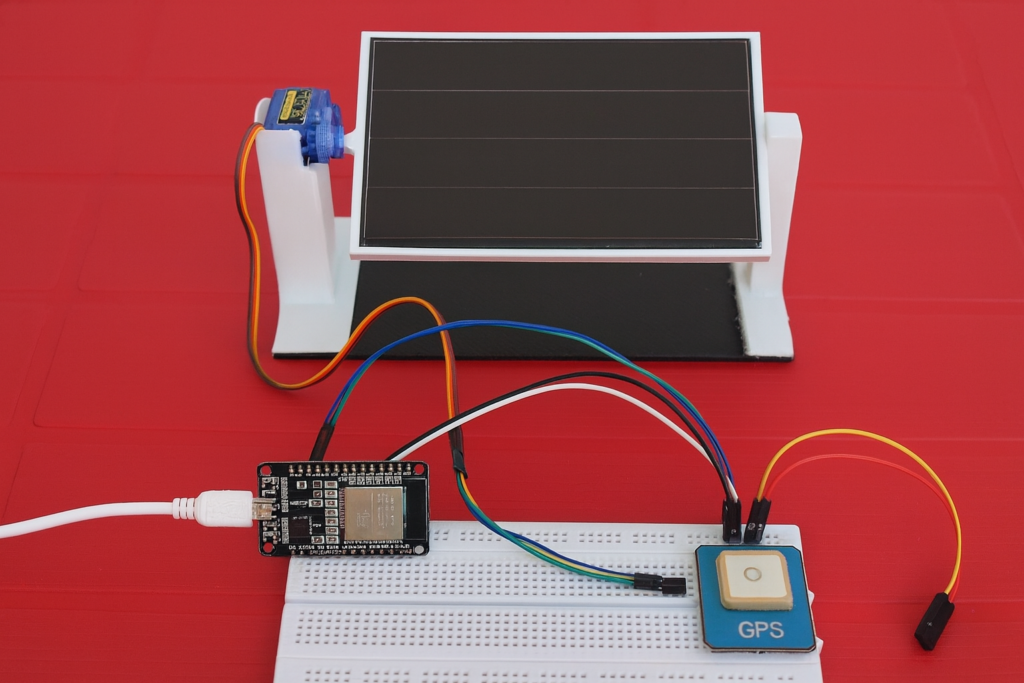
Components Used in GPS Based Automatic Solar Tracker
- ESP32 Development Board
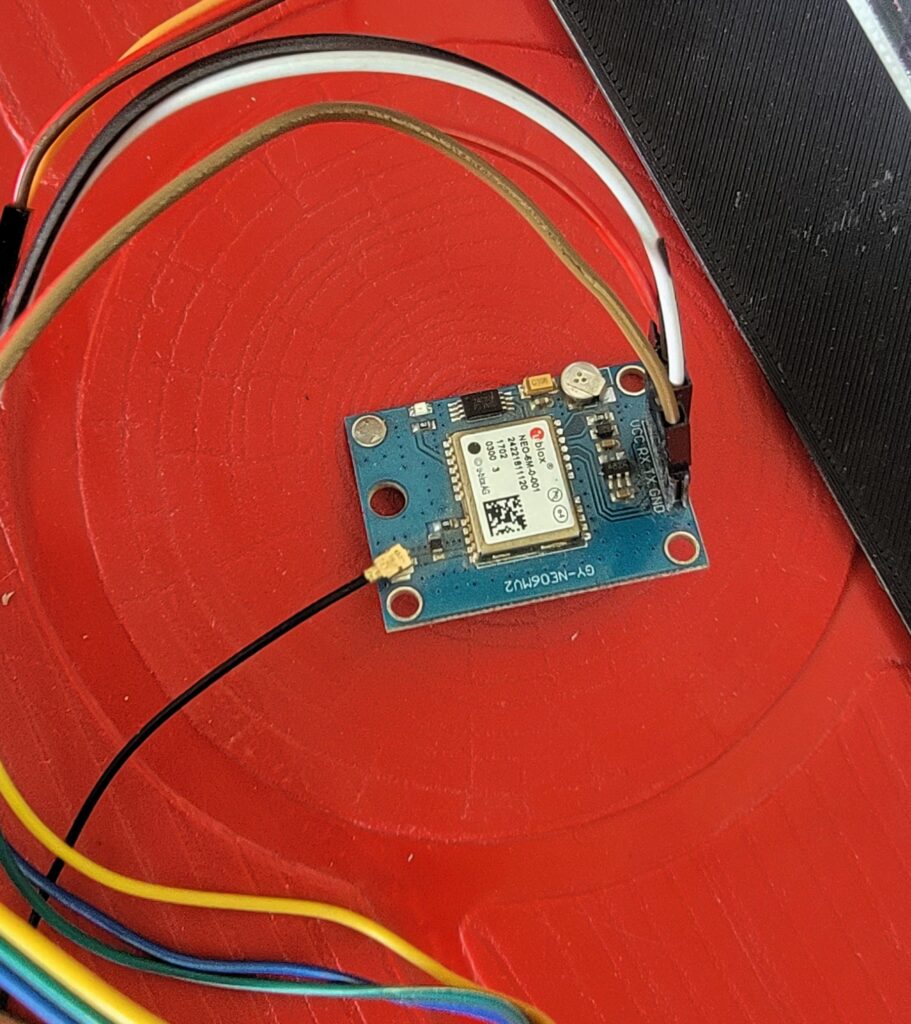
- GPS Module (NEO-6M or similar)
- Servo Motor (for demo movement)
- Solar Panel (prototype)
- Power Supply / Battery
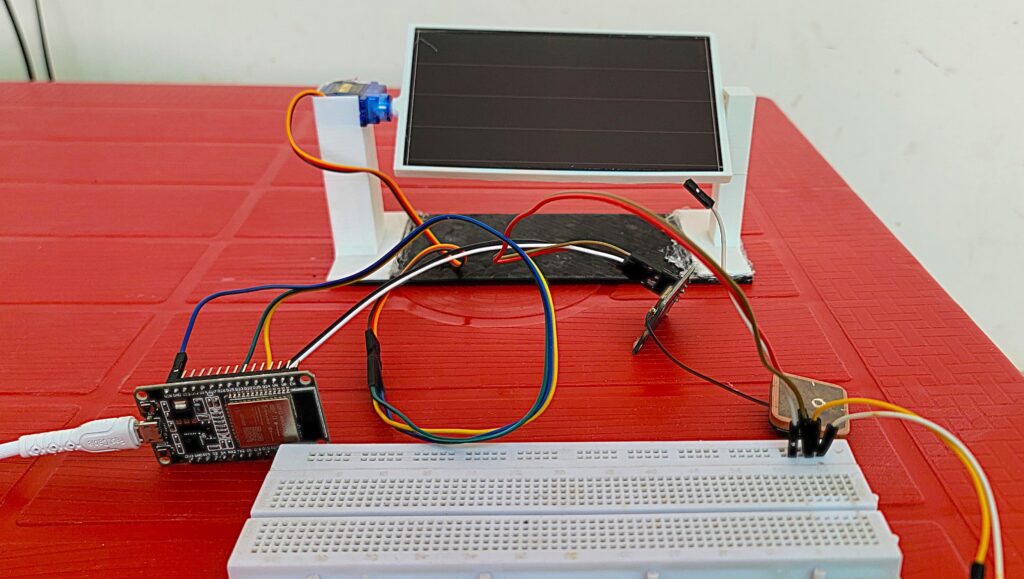
Working Principle of the GPS Based Solar Tracker
Unlike sensor-based trackers, this system uses mathematical algorithms to determine the exact position of the sun at any given moment.
Step 1: Acquire GPS Data
The GPS module provides:
- Latitude
- Longitude
- Current Date and Time (UTC)
This data is essential for calculating the sun’s position at your geographical location.
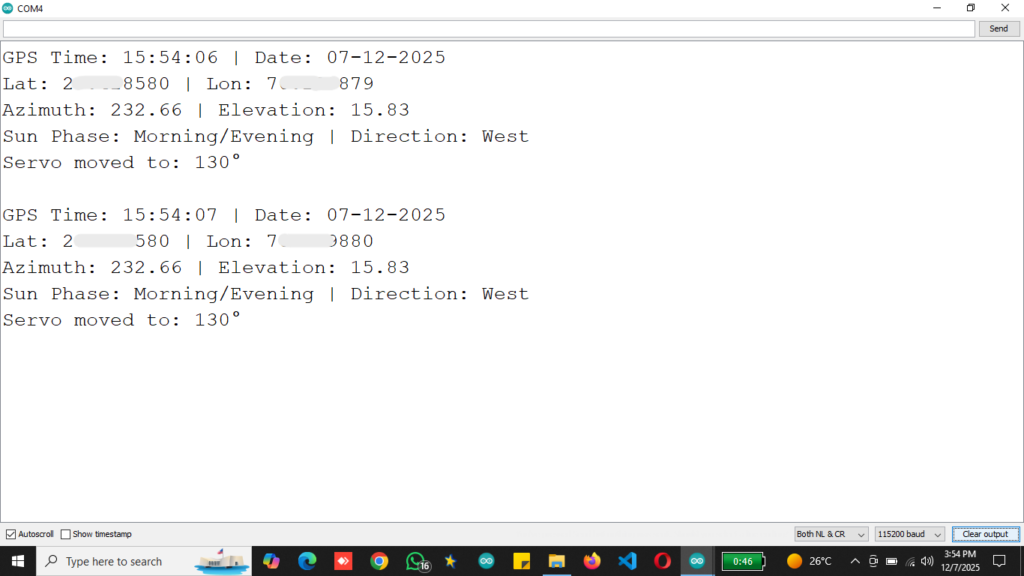
Step 2: Solar Position Calculations
The ESP32 processes the time and location to compute:
- Azimuth Angle
Direction of the sun along the horizon (East-West) - Elevation Angle
Height of the sun above the horizon
These calculations are based on well-known astronomical formulas, such as NOAA algorithms.
Step 3: Rotate the Solar Panel
The system uses the calculated angles to rotate the solar panel using a servo motor.
In a single-axis tracker, only the azimuth direction (left-right rotation) is controlled.
Step 4: Night Time Behavior
When the sun goes below a certain elevation angle, the system detects night time and moves the panel to a flat / default position to avoid:
- Dust accumulation
- Wind damage
- Mechanical strain

What Do Commercial Solar Trackers Use?
Commercial solar trackers typically do not use LDR sensors.
Instead, they rely on:
- Astronomical Algorithms
Similar to our project, they compute sun position mathematically. - GPS and RTC Modules
For accurate global time and precise geographic location. - Industrial Motors and Actuators
Stepper motors, DC motors, hydraulic or linear actuators.
Why We Don’t Need LDR Sensors in our Solar Tracker System?
Traditional trackers use pairs of LDR sensors to detect the brightest side and move the panel toward light.
But LDR systems have limitations:
- Poor performance during cloudy weather
- False readings due to reflections/shadows
- Require calibration
- Limited precision
- Sensitive to physical damage
In contrast, GPS + algorithm-based tracking works perfectly regardless of weather conditions, making it a more professional and commercial-grade approach.
Why ESP32 is Better Than Arduino Uno for this Project?
Although Arduino Uno can perform basic microcontroller tasks, ESP32 provides multiple key advantages that make it ideal for solar tracking:
1. Faster Processing Power
Solar calculations are computationally heavy.
ESP32 is tens of times faster than Arduino Uno.

2. Built-in Wi-Fi & Bluetooth
You can fetch:
- NTP Time (Internet clock)
- Cloud communication
- Remote monitoring
without extra modules.
3. Higher Memory
Storing large algorithms and lookup tables requires more RAM and flash memory, which ESP32 easily provides.
Single-Axis vs Dual-Axis Solar Tracker
This project demonstrates a single-axis solar tracker, which rotates horizontally (east to west).
However, the core working principle remains the same whether it is:
- Single-Axis
OR - Dual-Axis
A dual-axis tracker simply adds movement in the vertical elevation axis, increasing solar exposure.
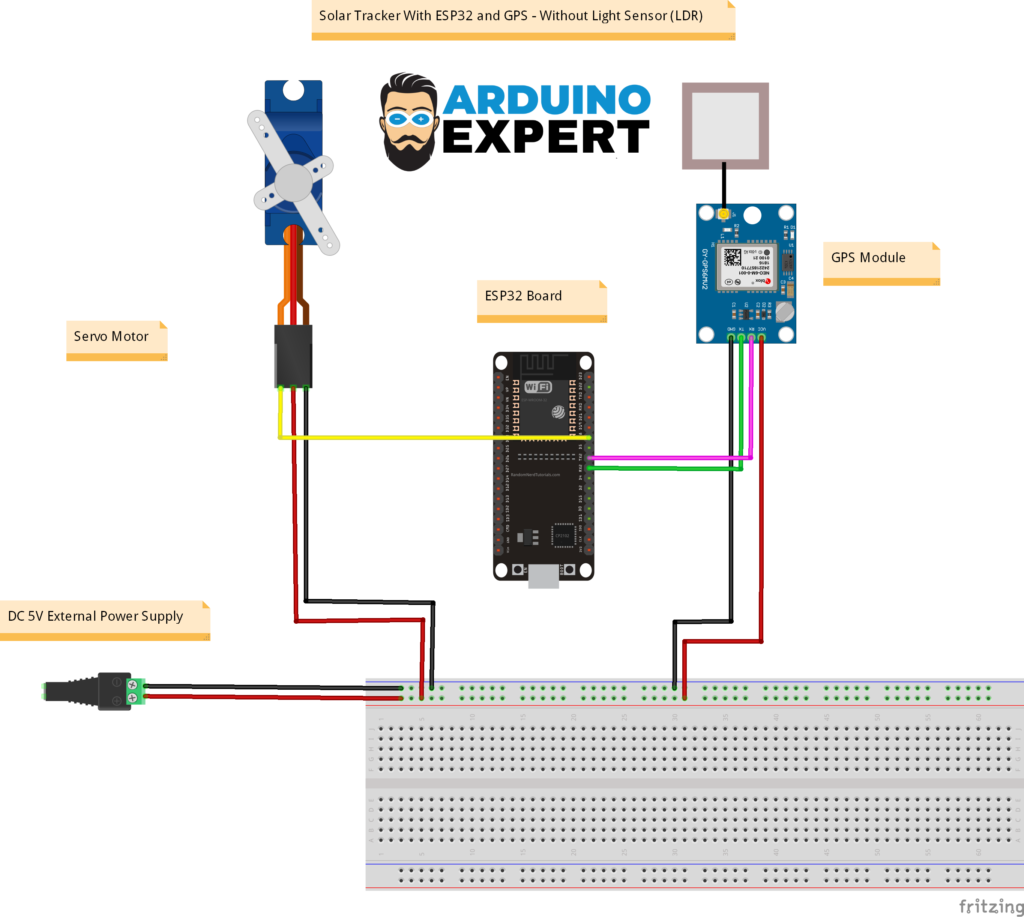
Circuit Diagram of GPS Solar Tracker with ESP32 and Servo Motor
External Power Supply and ESP32 share the same ground.
| ESP32 Pin | Connected To |
|---|---|
| RX2 (GPIO 16) | GPS TX |
| TX2 (GPIO 17) | GPS RX |
| GPIO 18 | Servo Signal |
Power Notes
- GPS module requires stable power, ideally regulated 3.3V
- Servo motors can draw high current, causing resets
- Best practice: use separate 5V 2A supply for servo
ESP32 Code for GPS Solar Tracker
#include <ESP32Servo.h>
#include <TinyGPS++.h>
#include <HardwareSerial.h>

// ==================== USER SETTINGS ====================
#define SERVO_PIN    18   // Servo control pin
#define SERVO_EAST   20   // Servo angle when panel points East
#define SERVO_WEST   160  // Servo angle when panel points West
#define TRACK_MIN_AZ 90   // Min azimuth considered for tracking
#define TRACK_MAX_AZ 270  // Max azimuth considered for tracking
int timezone = 5;         // UTC+5 (PKT)

// =======================================================

Servo azServo;
TinyGPSPlus gps;
HardwareSerial GPSSerial(1); // Use Serial1 for GPS (RX=16, TX=17)

// ---------- NOAA Solar Calculation ----------
double degToRad(double deg) { return deg * PI / 180.0; }
double radToDeg(double rad) { return rad * 180.0 / PI; }

void setup() {
  Serial.begin(115200);
  GPSSerial.begin(9600, SERIAL_8N1, 16, 17); // RX=16, TX=17 adjust as per your wiring
  azServo.attach(SERVO_PIN);
  Serial.println("GPS Solar Tracker Started!");
}

// ---------- Loop ----------
void loop() {
  while (GPSSerial.available() > 0) {
    gps.encode(GPSSerial.read());
  }

  if (gps.location.isValid() && gps.time.isValid() && gps.date.isValid()) {
    // Get GPS location
    double latitude  = gps.location.lat();
    double longitude = gps.location.lng();

    // Get GPS time & apply timezone
    int hour   = gps.time.hour() + timezone;
    int minute = gps.time.minute();
    int second = gps.time.second();
    int day    = gps.date.day();
    int month  = gps.date.month();
    int year   = gps.date.year();
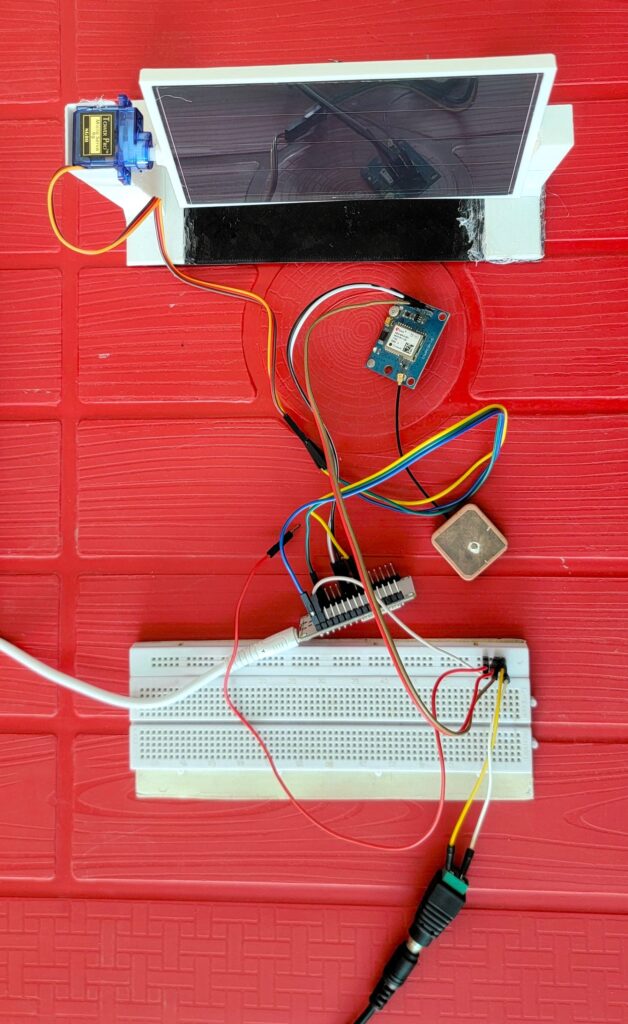
Automatic Solar Tracker System Project Setup:
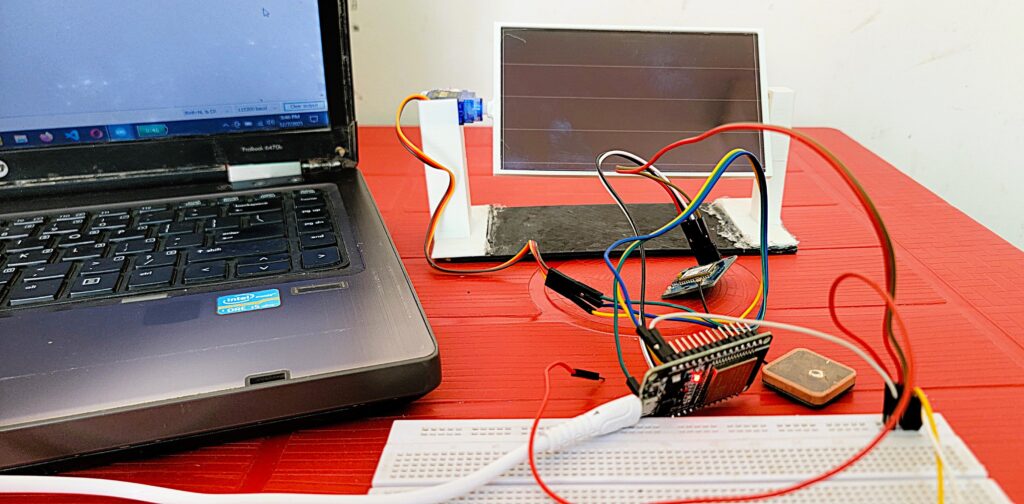
Working Video of Automatic Solar Tracker With GPS, ESP32 and Without LDR Sensors
Alternative Options for Automatic Solar Tracker If GPS is Not Used?
While a GPS module is the most accurate and autonomous way to obtain real-time location and time data, it is not mandatory for implementing an automated solar tracking system. If GPS is not available, there are several reliable methods to obtain the required date, time, and sometimes location for solar position calculation. These methods still allow the microcontroller to compute the sun’s azimuth and elevation accurately.
1. RTC Module (Real-Time Clock)
A Real-Time Clock module, such as the DS3231 or DS1307, can be used to provide accurate date and time to the ESP32 (or Arduino).
How it works:
- Set the date and time once during setup.
- The RTC keeps running on a coin cell battery, even when the system is powered off.
- The ESP32 reads time periodically from the RTC.
- Location (latitude/longitude) can be hard-coded in the program, since these do not change very often.
Advantages of RTC Module:
- Low power consumption
- No internet needed
- Accurate time maintenance
- Very stable in the long term
Limitations of RTC Module:
- Does not provide location automatically
- Time must be set manually initially
- Accuracy depends on temperature compensation (DS3231 is best)
2. NTP Time Using ESP32 Wi-Fi
Another convenient option is to use NTP (Network Time Protocol) over Wi-Fi. This allows the ESP32 to get the current date and time automatically from the internet without GPS or RTC.
How it works:
- ESP32 connects to a Wi-Fi network
- Fetches time from an online NTP server
- The algorithm uses this time along with stored location coordinates to compute sun position
Advantages of NTP Time:
- Fully automatic
- Highly accurate time sync
- No need for RTC or GPS
- Works indoors
Limitations of NTP Time:
- Requires Wi-Fi internet
- Not suitable for isolated/off-grid solar installations
- Needs periodic re-sync to maintain accuracy
3. GSM/GPRS Based Time and Location
A GSM module (like SIM800L, SIM900, A6, etc.) can also be used to obtain:
- Network time
- Approximate location (via cell towers)
How it works:
- The GSM module connects to the mobile network
- Obtains time from network infrastructure
- Optionally fetches cell tower-based location
- Data is transmitted to ESP32 via UART
Advantages: of GSM/GPRS
- Works without Wi-Fi
- Can operate in remote areas with SIM coverage
- Can support IoT data logging and remote monitoring
Limitations of GSM/GPRS:
- Requires SIM card and network availability
- Location accuracy lower than GPS
- Increased power consumption
4. Hard-Coded Time and Location (Manual Input)
In experimental or educational setups, time can be:
- Manually entered via Serial Monitor, or
- Set through buttons or keypad
Location is permanently Pre-Saved in code.
Advantages:
- Very simple
- No additional hardware needed
Limitations:
- Not automated
- Requires manual updates
- Not practical for outdoor systems
Advantages of GPS Based Automatic Solar Tracker
- No light sensors needed
- Accurate in all weather conditions
- Based on astronomy and math
- Low maintenance
- Commercial-grade approach
- More efficient energy harvest
- Smart automation and IoT ready
Applications GPS Based Automatic Solar Tracker
- Solar farms
- Home solar systems
- Street lights
- Agricultural solar installations
- Educational / research projects
- Portable or mobile solar setups
Conclusion
This project demonstrates a professional-grade solar tracking system built using ESP32, GPS module, and servo motor, without relying on fragile light sensors like LDR. By using sun position algorithms, the tracker can accurately determine azimuth and elevation angles, enabling intelligent movement of solar panels throughout the day.
Although this prototype is single-axis and uses a servo motor for demonstration, the same logic applies to dual-axis commercial systems powered by industrial actuators. The use of ESP32 offers significant advantages over Arduino Uno due to its higher processing power, built-in connectivity, and larger memory, making it ideal for GPS-based solar tracking applications.
This approach results in higher efficiency, reliability, and energy output, making it an excellent foundation for both DIY and commercial implementations.
Need Help or Assistance in Automatic GPS Solar Tracker System Project?
If you need Solar Tracker Project with or without Modifications or Customization then you can contact us through WhatsApp.
we can provide you Project Code along with Zoom Assistant, through Zoom meeting for Setup of this Project or any other Arduino Project of your need.
Learn More about the services we offer.
Frequently Asked Questions (FAQs)
What is a GPS-based solar tracker?
A GPS-based solar tracker is a system that uses location coordinates and time data from a GPS module to calculate the sun’s position in the sky. Based on these calculations, the controller adjusts the solar panel using a motor to keep it aligned with the sun throughout the day.
How is this different from an LDR-based solar tracker?
Traditional trackers use LDRs (Light Dependent Resistors) to detect sunlight.
This system does not rely on light sensors. Instead, it uses GPS data and solar position algorithms, making it more accurate and suitable for commercial applications, even in cloudy conditions.
Do I need internet for this project to work?
No.
The system uses GPS module data, so internet is not required.
However, if you don’t want to use a GPS module, you can use Wi-Fi to fetch time from NTP servers.
Is this a single-axis or dual-axis solar tracker?
This project is a single-axis solar tracker.
However, the working principle remains the same for both single-axis and dual-axis trackers. Only the mechanical design and number of motors change.
What type of motor is used in this project?
A servo motor is used to rotate the solar panel during demonstration.
In real installations, larger motors like:
1. Stepper motors
2. DC geared motors
3. Linear actuators
4. Encoder Motors
are used for better torque and durability.
How does the system calculate the sun’s position?
The ESP32 receives:
1. Latitude
2. Longitude
3. Current date
4. Current time
Using standard solar position algorithms, it calculates:
1. Azimuth angle (direction along horizon)
2. Elevation angle (height above horizon)
The motor moves panel according to these angles.
Does this system work at night?
No.
At night, when sunlight is not available, the system moves the solar panel to a flat (home) position, to reduce wear and wind resistance.
Why avoid LDR sensors in commercial trackers?
LDR-based systems have limitations:
1. Lower accuracy
2. Affected by clouds/shade
3. Hard to calibrate
4. Susceptible to dust and weather
5. Not reliable in harsh environments
Commercial systems prefer algorithm-based tracking because it is predictable, accurate, and weather-independent.
Can this system work without GPS?
Yes.
Alternate options to get time/location:
1. ESP32 Wi-Fi (NTP Server for time)
2. RTC Module (DS3231)
3. Hard-coded location coordinates (Pre Saved in the Code)
Then the system can still calculate the sun’s position.
Can I expand this project later?
Absolutely!
Some upgrade ideas:
1. Dual-axis tracking
2. Weather monitoring
3. Solar power logging
4. Mobile app monitoring
5. Solar MPPT controller integration
6. Battery management system
Can You Customize Solar Tracker Project?
Yes, We can customize GPS Solar Tracker Project as per your requirements. You can use Heavy Duty Motors.